Central Asian Shepherd Dog

- Origin
- Central Asia
- Type
- Livestock guardian
- Size
- Giant
- Height
- At least 65–70 cm (26–28 in)
- Weight
- At least 40–50 kg (88–110 lb)
- Coat
- Short or moderately long, with a heavy undercoat
- Colors
- White, black, gray, russet, straw, gray-brown, brindle or flecked
- Status
- Recognised by the FCI
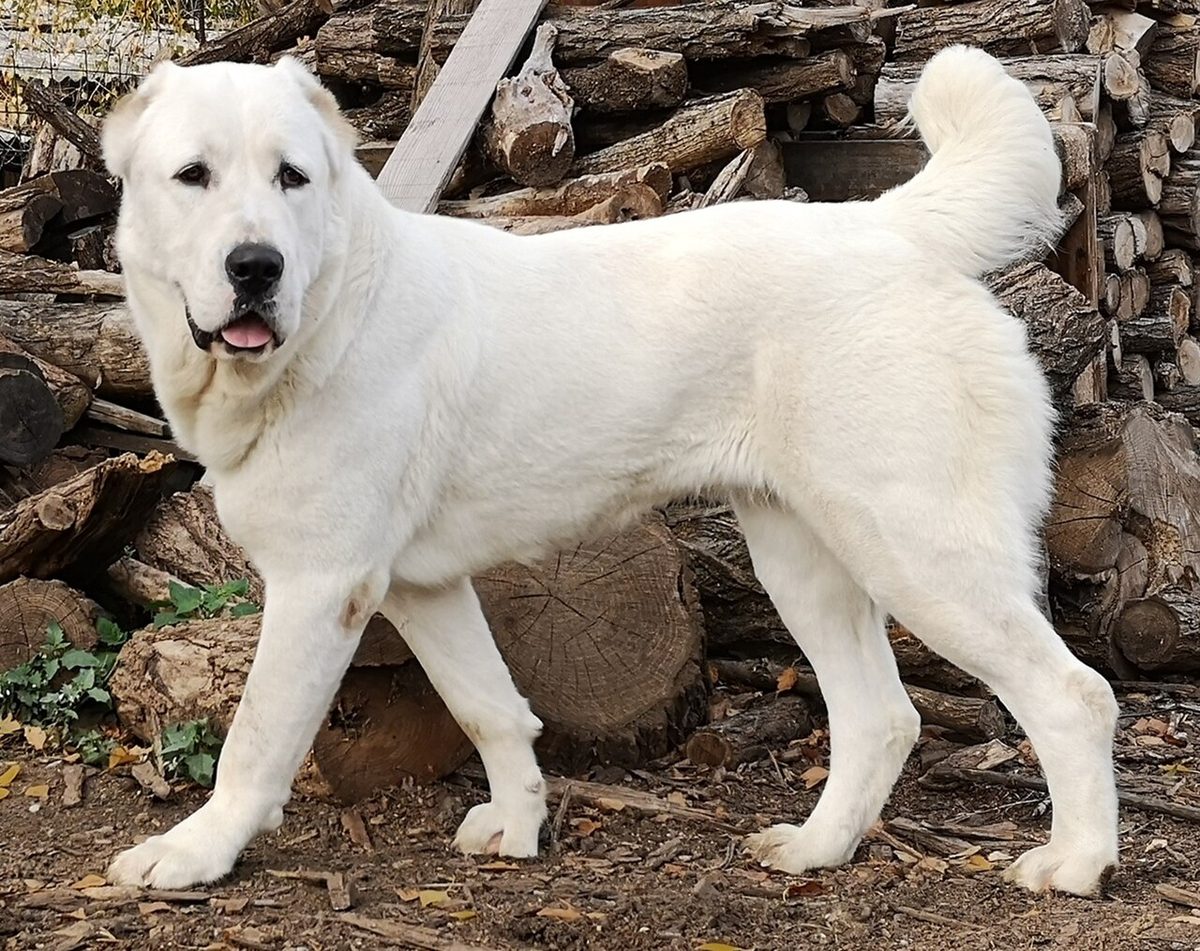
The Central Asian Shepherd Dog, also known as the Alabai, is a livestock guardian breed. It was traditionally kept to guard flocks of sheep and goats, and to protect people and property.
History
The breed’s ancestors come from a region bounded by the Urals, the Caspian Sea, Asia Minor and the northwest border of China. Native dogs and their crosses are still found in Kyrgyzstan, Tajikistan, Turkmenistan, Kazakhstan, Afghanistan, Uzbekistan and neighboring countries. The breed is genetically close to other guardian dogs of the wider region, such as the Georgian Shepherd, the Kangal and the Akbash.
Russian scientists have studied these dogs since the 18th century. After the revolution, the Soviet government sought working dogs for the Red Army and took the best animals to Russia. Over the decades this harmed the local population, and newly introduced breeds led to crossbreeding. Purebred dogs survived mainly with herders, enthusiasts and farms. The population is nevertheless considered stable, and breeders in Russia, other former Soviet republics and the countries of origin commonly exchange bloodlines.
In the breed’s homelands, herders traditionally met once a year and matched their strongest male guardians against each other. These contests were about dominance: the weaker dog usually backed down and injuries were mostly minor. Modern commercial dog fighting is a different matter and uses dogs from fighting lines.
In 1990 Turkmenistan approved a standard for the Turkmen Wolfhound. The dog is a symbol of national pride there. A 15-meter gold monument to it was unveiled in Ashgabat in 2020, and a national Alabay holiday, held on the last Sunday of April, was established in 2021.
Appearance
This is a robust dog of more than average size, with great strength. Males stand at least 70 cm and weigh at least 50 kg; females are at least 65 cm and 40 kg. The standard sets no upper limit. The body is as long as it is tall or a little longer, fairly broad, with a wide rump and a rib cage that looks very long. The head has no pronounced stop, and the neck is short and low-set with a dewlap. The legs are straight and heavy-boned.
The coat is short or moderately long over a heavy undercoat. Common colors are black and white, fawn from nearly white to deep red, and brindle, sometimes with a black mask. In practice the ears are cropped very short and the tail docked, except where such surgery is illegal.
The breed contains many types, which differ in size, color, head and coat.
Temperament
Central Asians are independent, curious and alert, yet hard to ruffle. To varying degrees they are territorial and protective against intruders, while being gentle with their family and safe with children. Guardian dogs must work together as a team, so excessive aggression is not typical of the breed.
Character depends a good deal on background. Dogs come from livestock guardian lines, from working lines bred in Russia for obedience and protection, and from fighting lines, which can be expected to show strong aggression toward other dogs. Pure show lines are rare, since most registries require working tests before breeding.
Facts on this page were checked against Wikipedia and may have changed since.