Rhodesian Ridgeback
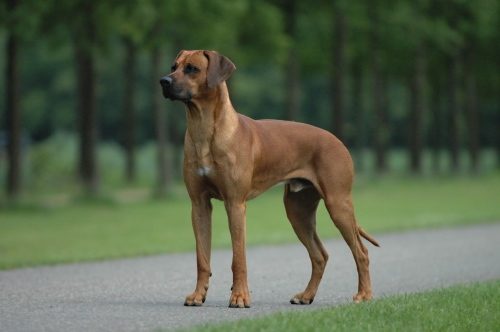

- Origin
- Southern Africa
- Type
- Scenthound
- Size
- Large
- Height
- 61–69 cm (24–27 in)
- Weight
- 32–36.5 kg (71–80 lb)
- Coat
- Short, dense, sleek and glossy
- Colors
- Light wheaten to red wheaten
- Life span
- About 12 years
- Status
- Recognised by the FCI, AKC, UKC and The Kennel Club
The Rhodesian Ridgeback is a large dog bred in Southern Africa. It descends from the ridged hunting and guard dogs of the Khoikhoi people, which early Cape colonists crossed with European dogs to produce a hound that could hold a lion at bay. Its mark is a strip of hair along the back that grows the wrong way.
History
When the Dutch began trading at the Cape in the mid 17th century, the Khoikhoi had a lean, muscular hunting dog about 46 cm tall, fearless as a guard and with a line of reversed hair along its back. Settlers soon took up these dogs. By the early 1800s they had also imported Greyhounds, Mastiffs, Great Danes, Bloodhounds and others, and crosses with the native dogs produced the Boer hunting dogs that are the Ridgeback’s chief forerunners. Genetic analysis points to a major contribution from the Great Dane.
In 1879 the missionary Charles Helm brought two ridged females to the Hope Fountain Mission in Matabeleland. The big-game hunter Cornelius van Rooyen bred his own dogs to them, and over the next 35 years his kennel developed dogs that could bay a lion: harassing it with quick darts and snaps, without attacking outright, until the hunter could shoot.
F. R. Barnes drafted the first standard in Bulawayo in 1922, basing it on the Dalmatian’s, and the South African Kennel Union approved it in 1927. Six Ridgebacks were taken to the United States in 1950, and the American Kennel Club recognised the breed in its hound group in 1955.
Appearance
The ridge begins just behind the shoulders with two whorls of hair, called crowns, and tapers to the level of the hips. It is about 5 cm across at its widest. Some purebred puppies are born without one, which is a disqualification in the show ring.
Males usually stand 64–69 cm and weigh about 36.5 kg; females are 61–66 cm and about 32 kg. The dog is very muscular. The coat is short, dense, sleek and glossy, from light wheaten to red wheaten. A little white on the chest and toes is allowed, and some dogs have a dark mask. The nose is black or liver, with dark eyes going with a black nose and amber eyes with a liver one.
Temperament
The FCI standard calls the breed dignified and intelligent. The UKC standard says it may be aloof with strangers but is never shy or aggressive. For all their size and athleticism, Ridgebacks are sensitive. Barnes warned that rough handling, especially of young dogs, makes them go to pieces. They accept correction that is fair and comes from someone they know and trust.
Care and health
A UK study found an average life expectancy of 12 years. Conditions known in the breed are hip dysplasia and dermoid sinus, a congenital neural-tube defect felt as a thin cord under the skin of the back. Hypothyroidism is a growing problem, and the breed is among those more often affected by degenerative myelopathy. Like other deep-chested dogs, it is prone to gastric dilatation volvulus, or bloat.
Facts on this page were checked against Wikipedia and may have changed since.