Black-backed Jackal

- Origin
- Eastern and Southern Africa
- Type
- Wild canid
- Size
- Medium
- Height
- 38–48 cm (15–19 in)
- Weight
- 6–13 kg (13–29 lb)
- Coat
- Reddish brown to tan with a black and silver saddle
- Life span
- About 7 years in the wild
- Status
- IUCN: Least Concern
The black-backed jackal (Lupulella mesomelas) is a wild canid native to Africa. It is one of the oldest living members of the dog family: fossils show it has lived in eastern and southern Africa for at least two to three million years with little change. It was long placed in the genus Canis, but DNA evidence shows that it and the side-striped jackal sit outside the wolf-like group, and both are now placed in the genus Lupulella.
Range and habitat
The species lives in two separate regions about 900 km apart. One covers the southern tip of the continent, including South Africa, Namibia, Botswana and Zimbabwe. The other lies along the eastern coast, including Kenya, Somalia, Djibouti, Eritrea and Ethiopia. Each region has its own subspecies, and the two have been apart for so long that some studies suggest they could be separate species.
The jackal prefers open country with little dense vegetation, but it occupies everything from arid coastal desert to areas with more than 2,000 mm of rain a year, as well as farmland, savanna and alpine areas. Its kidneys are well adapted to going without water. It also copes well with land altered by people, including fields and the edges of towns.
Appearance
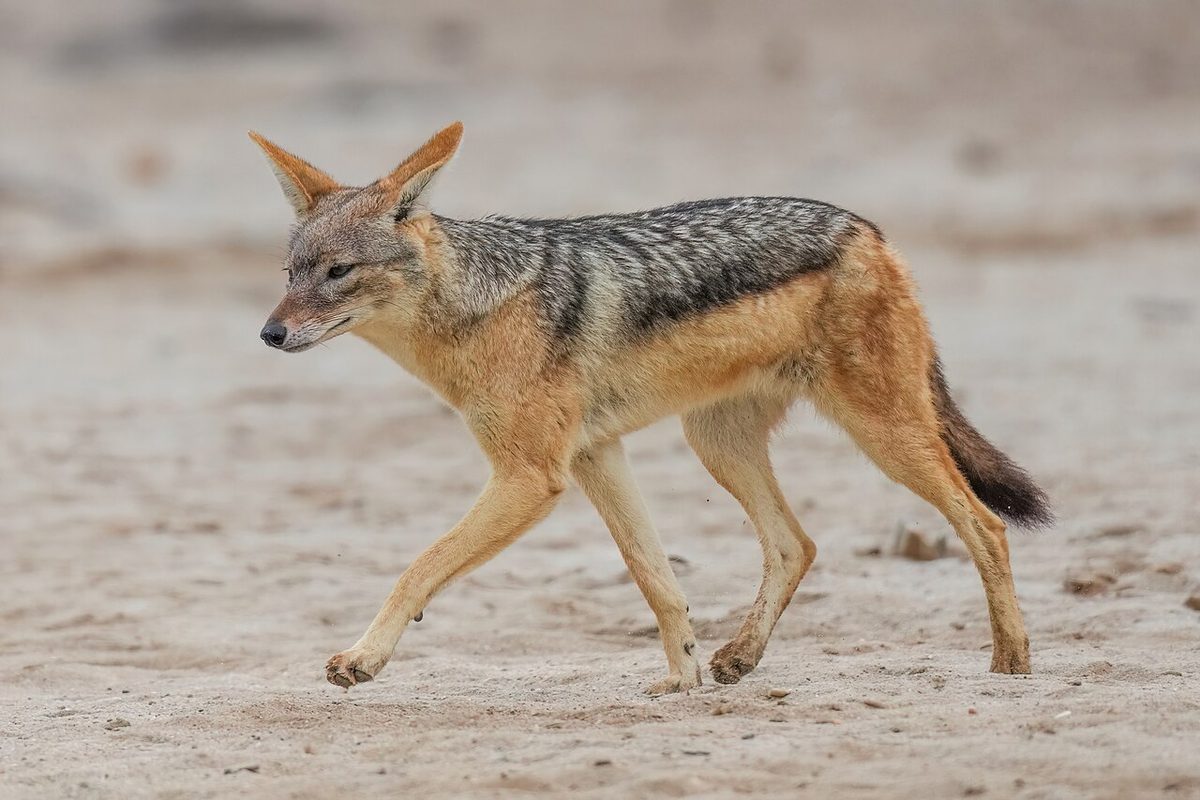
The black-backed jackal is fox-like, with a slender body, long legs and large ears. It stands 38 to 48 cm at the shoulder and weighs 6 to 13 kg. The base color is reddish brown to tan, strongest on the flanks and legs. A black saddle mixed with silvery hair runs from the shoulders to the base of the tail, set off from the rest of the body by a long black stripe along each flank. The tail is bushy with a black tip, and the lips, throat, chest and insides of the legs are white. The winter coat is a deeper reddish brown.
Behavior
The basic social unit is a monogamous pair that holds a territory, marking its borders with urine and feces and driving out intruders. Litters of one to nine pups are born after about 60 days. Older offspring often stay on to help feed and raise the next litter, which improves the pups’ survival. It is a very vocal species, yelping, howling, growling and cackling.
Black-backed jackals are opportunistic omnivores. They eat insects and other invertebrates, rodents, hares, young antelopes, birds, reptiles, carrion, fruit and human refuse; on coasts they take seabirds, seals and fish. A single jackal can kill a healthy adult impala. In the Namib Desert they spread the seeds of the nara melon.
They also take livestock, mainly sheep, and are major carriers of rabies, so they have long been hunted, trapped and poisoned. Attempts to wipe them out have never succeeded, and the population remains stable. In the wild they live about seven years on average.
Facts on this page were checked against Wikipedia and may have changed since.