Bergamasco

- Origin
- Italy
- Type
- Herding
- Size
- Large
- Height
- 54–62 cm (21–24 in)
- Weight
- 26–38 kg (57–84 lb)
- Coat
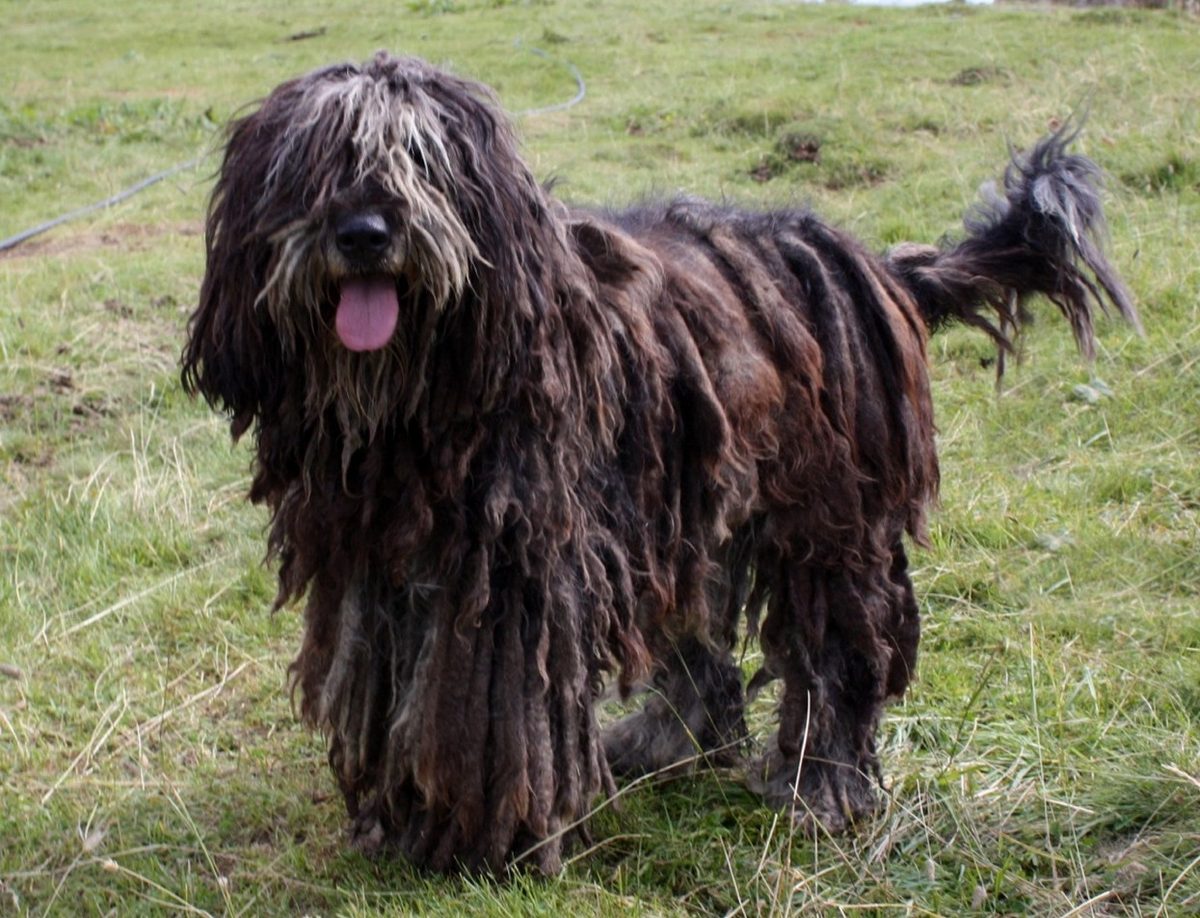
- Long and thick, forming felted mats
- Colors
- Gray, from very pale to black
- Status
- Recognised by the FCI and AKC
The Bergamasco is an Italian sheepdog tied to the Alpine and pre-Alpine regions of northern Italy. It was traditionally used there to move and manage sheep and cattle. Its most striking feature is a long, thick coat that mats into felted locks.
History
Nobody knows how the breed began. In 1781 G. von Albertini wrote of Bergamasco shepherds on the Splügenberg using large dogs with long, wool-like hair to guard and drive their flocks, and noted that single dogs could be trusted with groups of sheep during migration. A similar account followed in 1809 from Johann Jakob Römer and Heinrich Rudolf Schinz. A genetic study in 2018 found haplotypes shared with other European breeds, among them the Berger Picard, the Bernese Mountain Dog and the Briard.
A dog of this type was shown at the first Italian dog show, in Milan in 1881, and the first entry in the Italian stud book was made in either 1891 or 1898. In the first half of the twentieth century, war, changes in farming and the decline of migratory sheep keeping shrank the work these dogs had lived on.
The modern registered breed owes much to Pietro Rota, who bought a dog named Alpino di Valle Imagna from a shepherd. Alpino became an Italian champion and an influential sire, and served as a reference when a breed standard was drafted in 1946. A breed association followed in 1949. Other early kennels that worked to preserve the dog were Luigi Guidobono Cavalchini’s Valle Scrivia and Maria Schreiber-von Albertini’s Brahama. The Italian kennel club recognised the breed in 1956, and the FCI gave it full acceptance the same year. The American Kennel Club recognised it in 2015.
From 2011 to 2019, registrations in Italy averaged 97 a year, ranging from 48 to 149.
Appearance
The Bergamasco is a sturdy, rustic dog of medium size, solidly built and well proportioned. In outline it is nearly square or a little longer than tall. Males stand about 58–62 cm at the withers and weigh about 32–38 kg. Females are roughly 4 cm shorter and about 6 kg lighter on average.
The coat is long and thick and covers the whole dog. On the rear part of the body it forms long matted locks that protect against bad weather. On the front part the hair is coarse and falls in wavy ringlets like a goat’s, and on the head it is somewhat finer. The color may be any shade of gray, from very pale to matte black, and some tinges of isabella or fawn are allowed.
Facts on this page were checked against Wikipedia and may have changed since.