Cane Corso

- Origin
- Italy
- Type
- Mastiff
- Size
- Large
- Height
- 58–70 cm (23–28 in)
- Weight
- 40–50 kg (88–110 lb)
- Coat
- Short, dense and lustrous
- Colors
- Black, gray, fawn or dark wheaten; may be brindled
- Life span
- About 9 years
- Status
- Recognised by the FCI and AKC
The Cane Corso is an Italian mastiff. Today it is usually kept as a companion or guard dog and is sometimes used to protect livestock. In the past it hunted large game and herded cattle.
History
According to the international breed standard, the Cane Corso was once found over much of the Italian peninsula, but in more recent times survived only in Puglia, in the south. When the masseria system of share-cropping collapsed in the 1960s the dogs became rare. The modern breed was built up by selective breeding from a few surviving animals from about 1980.
A breed society, the Società Amatori Cane Corso, was formed in 1983. The Italian kennel club recognised the breed in 1994. The Fédération Cynologique Internationale accepted it provisionally in 1996 and fully in 2007, and the American Kennel Club recognised it in 2010. Between 2011 and 2019 some 3,000 to 4,250 dogs were registered in Italy each year.
Appearance
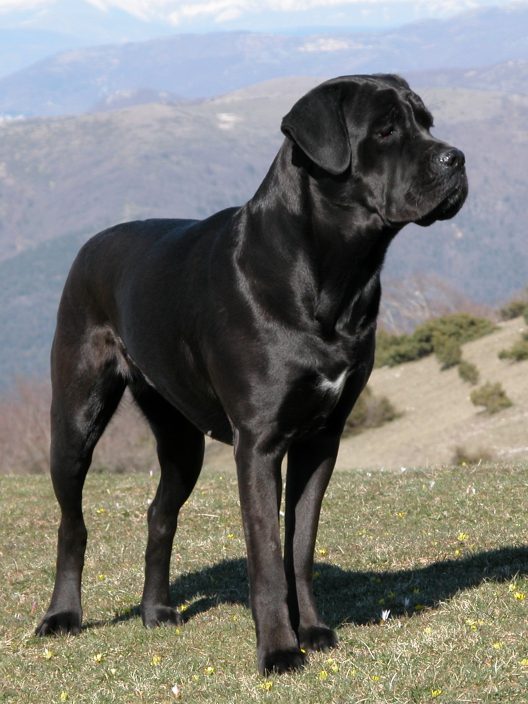
The Cane Corso is a large molosser, strong and muscular yet with some elegance, and a close relative of the Neapolitan Mastiff. Males stand about 62–70 cm at the withers and weigh 45–50 kg; females are about 4 cm shorter and 5 kg lighter. The head is large, a little over a third of the height at the withers in length, with a flat skull and a well-marked stop. The eyes are oval, set well apart and as dark as possible.
The coat is short, dense and glossy. It may be black, a shade of gray, a shade of fawn, or dark wheaten, and may be brindled. Small white markings on the chest, feet or nose are tolerated.
Temperament
To qualify for registration, dogs must pass a working trial. They are expected to stay calm around harmless strangers, to be unmoved by gunfire, and to defend their owner strongly against an attacker.
Care and health
The breed is genetically prone to elbow and hip dysplasia, patellar luxation and retinal dysplasia. It is also more likely than average to suffer from demodicosis, ectropion, entropion, bloat, hypothyroidism, idiopathic epilepsy, fungal ear infection and cherry eye.
A 2017 study of 232 dogs from 25 countries found an average lifespan of 9.3 years, which varied with coat color: black brindle dogs lived longest, at 10.3 years.
Facts on this page were checked against Wikipedia and may have changed since.