Bengal Fox

- Origin
- Indian subcontinent
- Type
- Wild canid
- Size
- Small
- Weight
- Up to 3.6 kg (7.9 lb)
- Colors
- Buff to silver-gray, with reddish legs and a black-tipped tail
- Status
- Least Concern (IUCN)
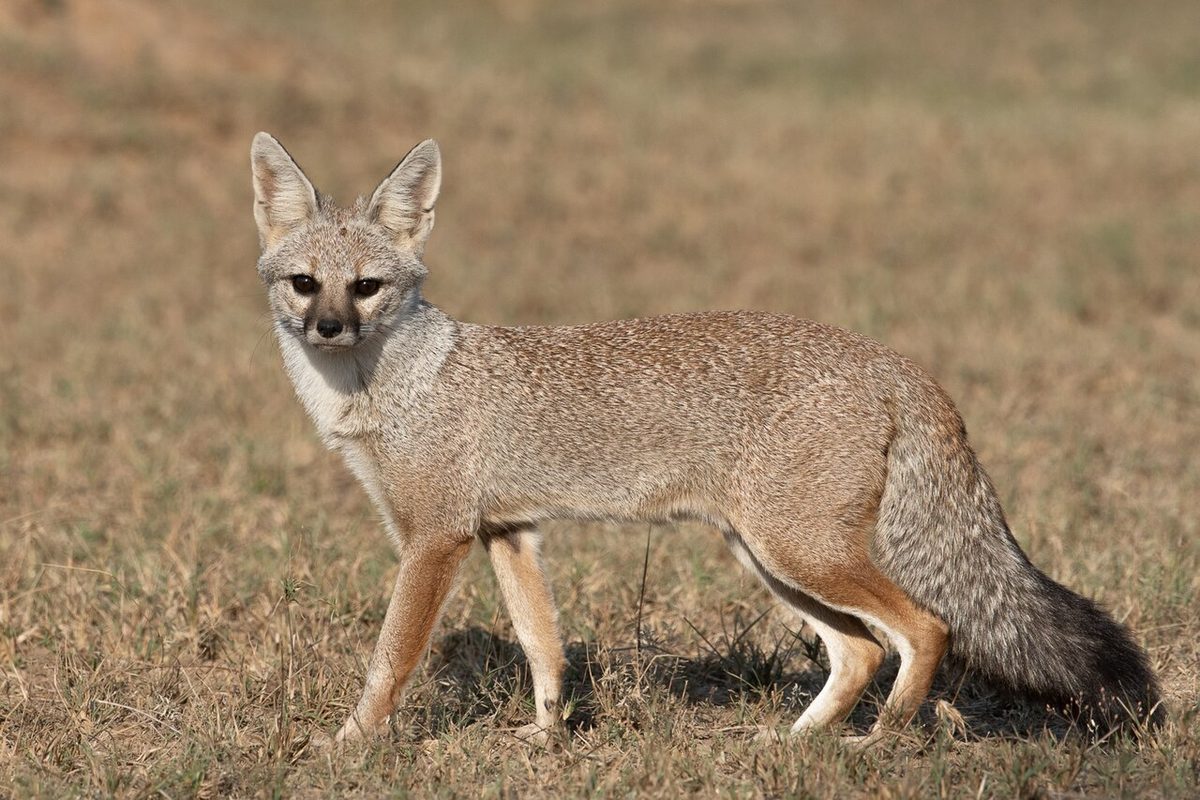
The Bengal fox (Vulpes bengalensis), also called the Indian fox, is a small wild fox found only on the Indian subcontinent. It lives in dry, open country and feeds on insects, small animals and fruit.
Range and habitat
The species ranges from the Himalayan foothills and the Terai of Nepal through southern India, and from southern and eastern Pakistan to eastern India and southeastern Bangladesh. Its range is bounded by the Himalayas and the Indus valley.
It favors semiarid, flat to rolling land with scrub, thorn or short grass, and avoids dense forest, steep ground, tall grassland and true desert. It usually occurs at low densities, and numbers rise and fall with the supply of prey and with outbreaks of canine distemper and rabies.
The greatest threat is loss of unprotected habitat as grassland is turned over to farming, industry and biofuel plantations. The fox is also hunted for its skin and flesh, and its body parts are used in traditional medicine. Indian law forbids hunting it, and the Indian populations are listed on CITES Appendix III. The IUCN lists the species as Least Concern.
Appearance
The Bengal fox has a long, pointed muzzle, long pointed ears and a bushy, black-tipped tail about half to three fifths the length of its head and body. The coat varies between populations and seasons, but is generally grizzled reddish gray above and paler on the sides and belly, with brownish or reddish legs. The backs of the ears are dark brown edged with black, and the lips are black.
Males measure about 50 cm (20 in) in head and body, with a 29 cm (11 in) tail, and weigh 2.7–3.6 kg (6.0–7.9 lb). Females are a little shorter and weigh under 1.8 kg (4.0 lb).
Behavior
Bengal foxes are active mainly at dusk and at night, spending the warm hours under vegetation or in dens. They use simple dens with two openings for short rests, complex dens with many openings, and shelters under rocks. The basic social unit is a breeding pair whose bond can last for years, though several adults are sometimes seen sharing a den. They are not especially wary of people and can live near settlements.
They eat insects such as grasshoppers, termites, ants and beetles, as well as rodents, small birds, reptiles, eggs and fruit. Their calls include a chattering cry that seems to mark territory, along with growls, whimpers and whines, and they can be heard howling in groups at night.
Mating takes place in December and January over most of the range. After about 50–53 days, two to four pups are born in a den, and both parents rear and guard them. Pups are fully weaned three to four months after leaving the den, and many die in their first months.
Facts on this page were checked against Wikipedia and may have changed since.