Bat-Eared Fox

- Origin
- Eastern and Southern Africa
- Type
- Wild canid
- Size
- Small
- Height
- 30–40 cm (12–16 in)
- Weight
- 3–5.3 kg (6.6–11.7 lb)
- Coat
- Tan fur with gray agouti guard hairs
- Colors
- Tan and gray, with black muzzle, mask, legs and tail tip
- Life span
- Up to 9 years in the wild; 14–17 years in captivity
- Status
- Least Concern (IUCN)
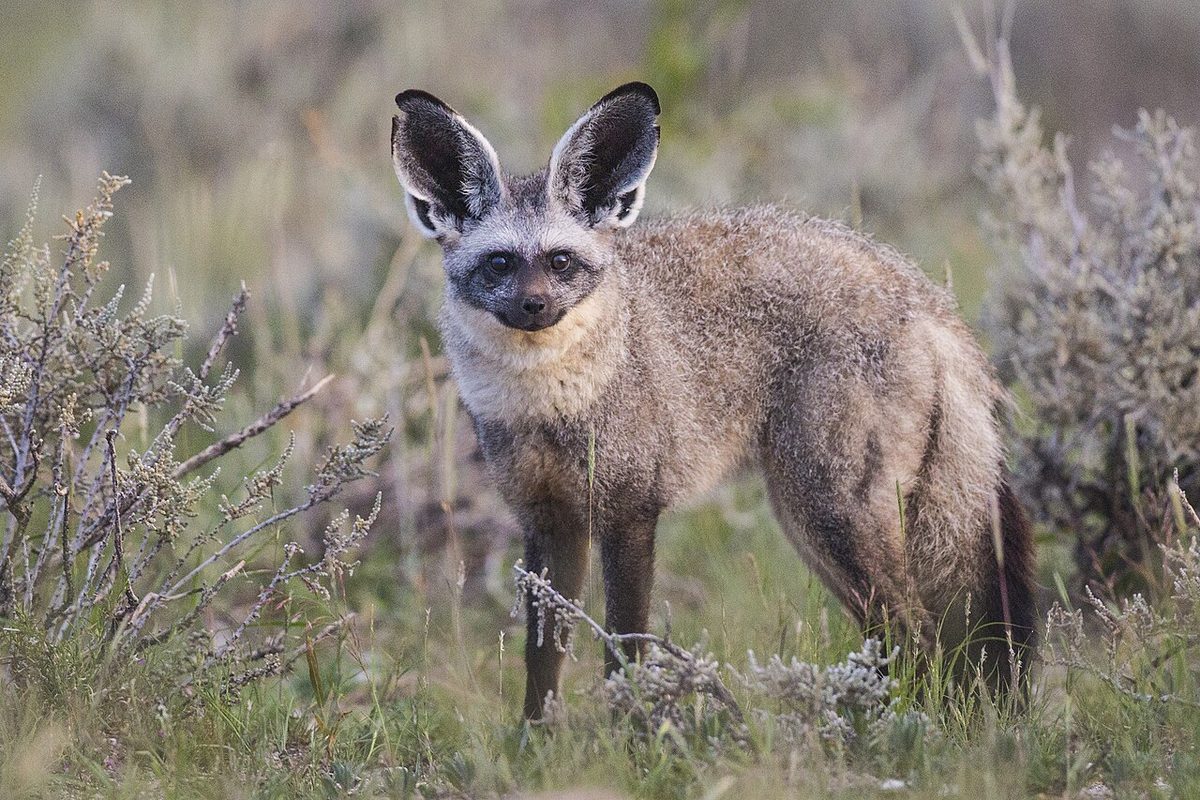
The bat-eared fox (Otocyon megalotis) is a small wild canid of the African savanna. It is the only living member of its genus and, genetically, not a true fox. It is named for its very large ears, and it is the only canid that lives almost entirely on insects.
Range and habitat
The species lives in two populations about 1,000 km (620 mi) apart, each counted as a subspecies. One ranges from southern Sudan, Ethiopia and Somalia through Uganda and Kenya to southwestern Tanzania. The other lives in southern Africa, from Angola through Namibia and Botswana to South Africa, and east to Mozambique and Zimbabwe.
Bat-eared foxes are adapted to dry and semi-dry country. They favor short grassland, the drier parts of the savanna, woodland edges and open acacia woodland, and they prefer bare ground or places where grazing animals keep the grass short. When threatened they hide in tall grass and thick scrub. They dig their own dens, which they use to raise young and to shelter from wind and extreme temperatures.
Appearance
Adults weigh 3–5.3 kg (6.6–11.7 lb) and stand 30–40 cm (12–16 in) at the shoulder. Head and body measure 46–66 cm (18–26 in) and the tail 23–34 cm (9–13 in). The ears are 11–13 cm (4.3–5.1 in) long. Females are generally larger and heavier than males.
The fur is tan with gray agouti guard hairs, paler on the throat and underside. The legs darken to brown or black at the feet. The muzzle, face mask and the tip and top of the tail are black, and the insides of the ears are white. The East African subspecies tends to be buff with dark brown markings in place of black.
The big ears help shed heat and are used to find prey. The teeth are small and blunt, and there are more of them than in any other canid: 46 to 50 in all. The jaw can open and close five times a second.
Behavior
Bat-eared foxes are social. In southern Africa they live in pairs with their pups. In eastern Africa they may live in pairs or in family groups of one male and up to three related females. Group members forage, play, rest and groom each other together.
Harvester termites can make up 80–90 percent of the diet. When these are scarce the foxes eat other termites, ants, beetles, crickets, grasshoppers, scorpions and spiders, and now and then small rodents, birds, eggs, reptiles, berries and wild fruit. They find prey mainly by sound, walking slowly with the nose low and the ears tilted forward. They have not been seen drinking from open water and get moisture from their food.
In eastern Africa they are mostly active at night. In southern Africa they forage at night in summer and by day in winter.
Pregnancy lasts 60–70 days and a litter has one to six pups. Unusually among canids, the male does most of the caring: he grooms, guards and carries the pups while the female forages to keep up her milk. Young leave the family at five to six months.
There are no major threats to the species. Hunting, drought and diseases such as canine distemper, parvovirus and rabies can reduce numbers locally, and black-backed jackals are the main danger to pups.
Facts on this page were checked against Wikipedia and may have changed since.