Russkiy Toy

- Origin
- Russia
- Type
- Toy and companion
- Size
- Toy
- Height
- 20–28 cm (8–11 in)
- Weight
- 1.5–4 kg (3–9 lb)
- Coat
- Smooth and short, or long with fringed ears and feathered legs and tail
- Colors
- Black and tan, blue and tan, brown and tan, or red
- Status
- Recognised by the FCI and UKC; in the AKC Foundation Stock Service
The Russkiy Toy, known in English as the Russian Toy, is a very small dog bred in Russia from the English Toy Terrier. It comes in two coats, smooth and long. It was first bred as a ratter and watchdog and as a companion for the Russian nobility. It is often compared with the Chihuahua, but the two are not closely related.
History
English-style terriers were in Russia by the early 18th century; one that belonged to Peter the Great is preserved in the Museum of Zoology in Saint Petersburg. Eleven Russian Toys were shown in Saint Petersburg in May 1907. After the October Revolution the dogs fell from favor because of their link with the aristocracy, and by 1947 only one was shown in the city. Breeders worked with the few that remained, most without pedigrees, and in the country’s isolation a new breed took shape, distinct from the English dog.
The long coat first appeared in 1958 with a dog named Chikki, born to two smooth-coated parents. Evgeniya Fominichna Zharova of Moscow bred from him, and the variety became known as the Moscow Toy Terrier. A standard for both varieties was written in 1966, and in 1988 they were joined under the name Russian Toy Terrier.
After the fall of the Iron Curtain, imported breeds nearly drove the Russian Toy to extinction a second time, until a new generation of breeders revived it. It was almost unknown outside Russia before the 1990s; Finland, where the first dogs arrived in 1988, now has an especially strong breeding program. The FCI recognized the breed provisionally in 2006, dropping Terrier from the name, and definitively in 2017. The United Kennel Club and the AKC’s Foundation Stock Service accepted it in 2008.
Appearance
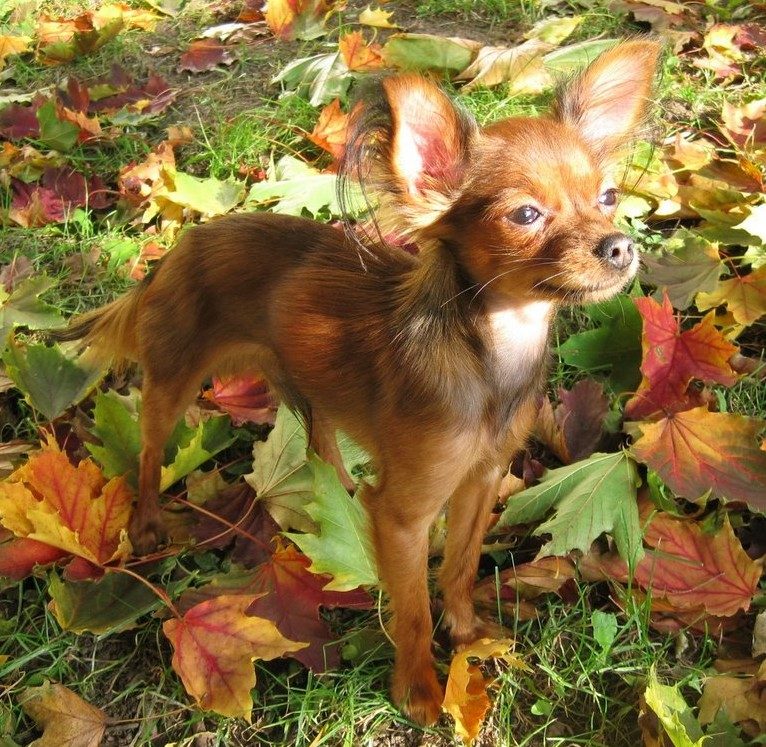
The Russkiy Toy stands 20 to 28 cm and weighs 1.5 to 4 kg. It has a small head with large round eyes and triangular ears. Where docking is banned, the tail is carried in a sickle curve. The smooth coat is short, shiny and close-lying. The long-coated dog has feathering on the legs and tail and a fringe 3 to 5 cm long on the ears, fully grown by the age of three. Both coats can appear in one litter.
There are four main colors: black and tan, blue and tan, brown and tan, and solid red in various shades, including sable.
Temperament
Russian Toys are commonly described as cheerful and vocal. They form deep bonds with their owners and become very attached to the family. They are protective, which makes them wary of people they do not know.
Care and health
Because the breed was so little known outside Russia, few details of its health are on record. Puppy teeth often fail to fall out and have to be removed by a veterinarian; left in place they can lead to tartar, decay, gum disease and misaligned teeth. The breed can suffer from patellar luxation, and its small, fine build makes bone fractures a risk. Litters are small, typically one to three puppies.
Facts on this page were checked against Wikipedia and may have changed since.