Prague Ratter

- Origin
- Czech Republic
- Type
- Toy and companion
- Size
- Toy
- Height
- 20–23 cm (8–9 in)
- Weight
- 1.5–3.5 kg (3.3–7.7 lb)
- Coat
- Short, smooth and glossy, or long with fringes
- Colors
- Black and tan; also brown, blue or lilac and tan, yellow, red and merle
- Life span
- 12–14 years
- Status
- Recognised by the FCI
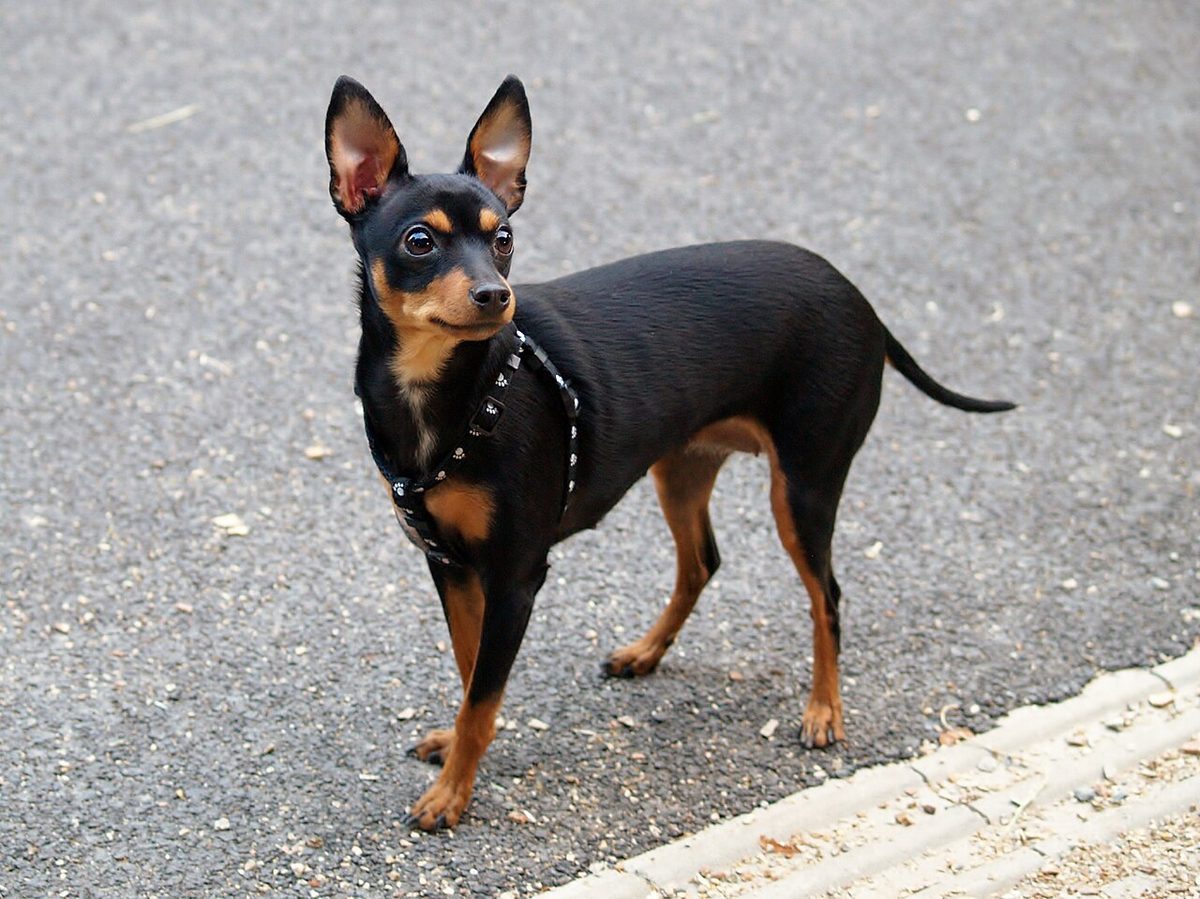
The Prague Ratter, in Czech Pražský Krysařík, is a very small dog from the Czech Republic that is rarely seen outside its home country. It resembles the Chihuahua and the Miniature Pinscher.
History
Czech breeders count the ratter among the oldest Czech breeds and point to mentions of such dogs in medieval chronicles. The Polish king Bolesław II is said to have had two brought from Bohemia, and Charles IV is said to have given three to Charles V of France in 1377. As the name says, the dogs caught rats, in palaces and ordinary houses alike. Legend adds that in royal households they walked the tables and tasted the food to protect their owners from poison. In time they moved from court to farmhouse and town, and then into ladies’ salons as pets.
The breed lost favor in the 19th century when the Miniature Pinscher came into fashion. A first revival, with stud books, began at the end of that century, but two World Wars and the communist period undid the work and the books were lost. The modern breed dates from the 1970s, when Jan Findejs and Rudolf Šiler led a second revival. The first dog was entered in the new studbook in 1980.
Until the end of the 20th century the breed was found only in the Czech Republic and Slovakia. Several hundred now live abroad, and clubs exist in a number of countries. The Fédération Cynologique Internationale acknowledged the breed in 2019. Only about 6,000 are registered worldwide.
Appearance
The Prague Ratter stands 20 to 23 cm (8 to 9 in) tall and weighs 1.5 to 3.5 kg (3.3 to 7.7 lb).
There are two coats. The short one is smooth, glossy and thick; the long one has fringes on the ears, legs and tail. Black and tan is the original and most common color. Others approved more recently include brown and tan, blue and tan, lilac and tan, yellow, red and merle.
Temperament
This is a lively, spirited little dog that attaches itself closely to its people, enjoys affection and is happy to be a lap dog when things are quiet. It is intelligent, obedient and eager to please, and learns tricks and tasks readily. It can be sensitive to criticism and responds best to rewards. It is said to be quieter than many small breeds.
It adapts well to apartment life but still likes long walks and games outdoors, and can be trained for agility, obedience and tracking. Its hearing and sense of smell are keen, and it has a strong prey drive: it will go after squirrels, rats and mice.
Care and health
The breed is thought to have no major health problems and lives for 12 to 14 years. It is prone to tartar and gum disease, and puppy teeth are sometimes retained. Because the dogs are so small, broken bones are a risk, most often in the forearm and the metacarpus. Patellar luxation, which is common in small breeds, and digestive troubles also occur. Litters are small, with one to three puppies.
Facts on this page were checked against Wikipedia and may have changed since.