Argentine Dogo
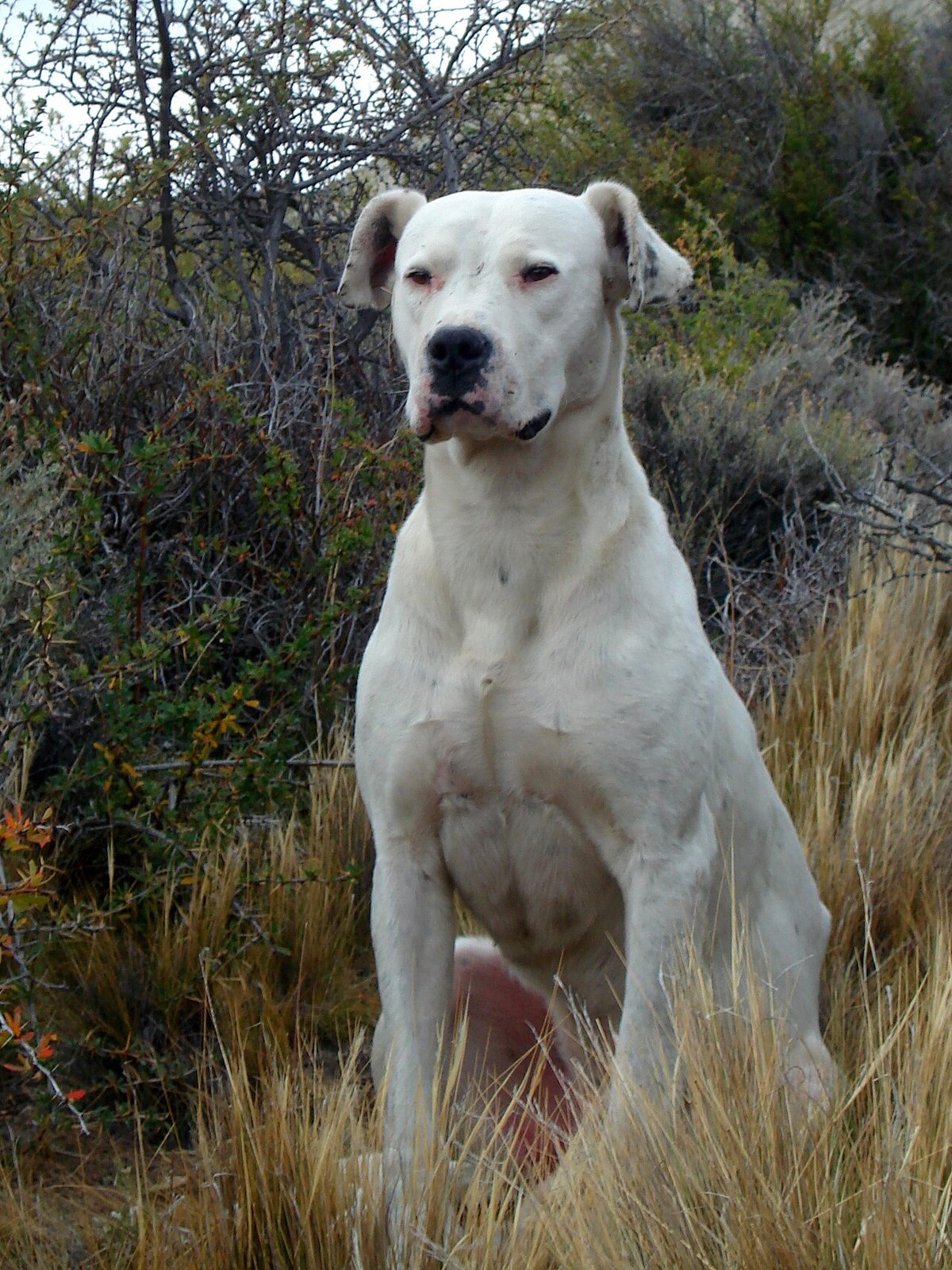

- Origin
- Argentina
- Type
- Mastiff
- Size
- Large
- Height
- 60–68 cm (24–27 in)
- Weight
- 40–45 kg (88–100 lb)
- Coat
- Short
- Colors
- White
- Life span
- 10–12 years
- Status
- Recognised by the FCI
The Argentine Dogo, or Dogo Argentino, is a large white dog of mastiff type from Argentina. It was created in the early twentieth century in Córdoba, in the center of the country, as a hunting dog for big game such as wild boar, peccaries and pumas.
History
The breed was the project of Antonio Nores Martinez, a young student from Córdoba, who began work in the 1920s together with his brother Augustin. He wanted a big-game dog with the fighting spirit of the old Córdoba fighting dog, a bulldog-type breed that is now extinct, but larger and stronger.
He began with a Bull Terrier bitch and a spotted fighting dog of bulldog type, then bred on from their offspring, keeping the white dogs and discarding any with an undershot jaw. A Pyrenean Mastiff bitch was added in the eighth generation, and by the twelfth the dogs were breeding true. Later crosses brought in the Irish Wolfhound, Boxer, Great Dane, Bull Terrier, Dogue de Bordeaux and Spanish Mastiff.
Nores Martinez presented the breed to the hunters’ club of Buenos Aires in 1947, and a standard appeared in the magazine Diana the following year. He was murdered in 1956. His brother Augustin, who served as an ambassador, went on promoting the Dogo on his travels. The Fédération Cynologique Internationale gave the breed full acceptance in 1973.
Appearance
The Dogo is a large dog. Males stand 60–68 cm (24–27 in) at the withers and females 60–65 cm (24–26 in). Males weigh around 40–45 kg (90–100 lb) and females a little less. The body is slightly longer than the dog is tall, by no more than a tenth.
The coat is short and always white. One black or dark patch on the head is allowed, provided it covers no more than a tenth of the head. The muzzle is about as long as the skull.
Temperament
The notes describe a working hunter rather than a character: the Dogo has a good nose, speed and stamina, and is still kept mainly for hunting large game. It is sometimes trained for police or military work.
Care and health
Like a number of other breeds, the Dogo has an inherited tendency to congenital deafness. It is also predisposed to laryngeal paralysis-polyneuropathy complex. Dogs usually live for about 10 to 12 years.
Keeping the breed is banned or restricted in a number of countries, among them Australia, parts of Austria, the Cayman Islands, Cyprus, Denmark, Fiji, Hong Kong, Iceland, New Zealand, Norway, Singapore, Turkey, Ukraine and the United Kingdom.
Facts on this page were checked against Wikipedia and may have changed since.