Schipperke
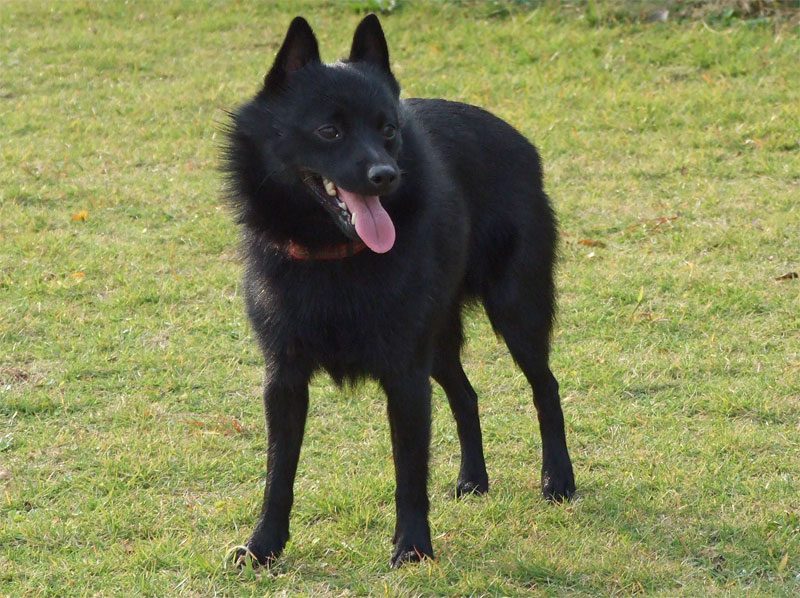

- Origin
- Belgium
- Type
- Spitz
- Size
- Small
- Height
- 31–34 cm (12–13 in)
- Weight
- 3–9 kg (7–20 lb)
- Coat
- Double coat with a ruff and culottes
- Colors
- Usually black; rarely cream or liver-red
- Life span
- About 13 years
- Status
- Recognised by the FCI and AKC
The Schipperke is a small Belgian dog believed to have originated in Flanders in the 1600s. In Belgium it is regarded as a small shepherd dog, while DNA research shows a close relationship to the spitz family.
History
The Schipperke’s story appears to begin with a black shepherd dog of the 17th century called the Leuvenaar, a dog of about 40 pounds (18 kg) kept around Louvain to guard flocks and transport. It is thought to be the ancestor of both the Schipperke and the larger black Belgian Shepherd, the Groenendael.
Before the present name was adopted, the dogs were known as “Spits” or “Spitzke”, a common term for a small dog with pointed ears, and sometimes as “Moorke”, meaning little black animal. They were recognized as a formal breed in the 1880s, and the standard was written in 1889.
“Schipperke” is usually translated from Flemish as “little boatman” or “little captain”. The dogs were sometimes seen on barges, but that was never their main job. Around Leuven and Brussels the word “scheper” meant shepherd, so the name may well mean “little shepherd”. In the United States the breed is often, and wrongly, called the Belgian canal barge dog.
During the Second World War the Belgian Resistance used Schipperkes to carry messages between hideouts.
Appearance
The Schipperke is small and sturdy, with pointed ears carried upright on top of the head. The coat is double: a soft, fluffy undercoat under a longer, harsher outer coat with a shine to it. A long ruff surrounds the neck and continues as a strip toward the rear, and the longer fur on the hind legs is known as culottes.
Most Schipperkes are black. Some are blond or cream, and very rarely liver-red; cream and liver dogs are not accepted at most shows. Males average 33.6 cm (13.2 in) in height and females 31.2 cm (12.3 in). The weight is usually 3 to 9 kg (7 to 20 lb).
Care and health
The Schipperke has few particular health problems. A UK Kennel Club survey found a median lifespan of 13 years, with about one dog in five reaching 15 or more. Inactivity and overfeeding are harmful to the breed and can lead to joint, tooth, heart, lung and digestive trouble.
The main orthopedic problems are luxating patella and Legg-Perthes syndrome, which affect the knee and hip. Some dogs show a tendency to epilepsy. A genetic disease called MPS IIIB, which among dogs occurs only in Schipperkes, is carried by at most 15 percent of the breed. Signs appear between two and four years of age and affect balance and the ability to manage obstacles such as stairs. There is no cure, but a DNA test has been available since 2003.
DNA studies also show that inbreeding in the breed is steadily rising.
Facts on this page were checked against Wikipedia and may have changed since.