Bloodhound

- Origin
- Belgium
- Type
- Scenthound
- Size
- Large
- Height
- 58–72 cm (23–28 in)
- Weight
- 40–54 kg (88–119 lb)
- Coat
- Short and hard
- Colors
- Black and tan, liver and tan, or red
- Life span
- About 9 years
- Status
- Recognised by the FCI, AKC and The Kennel Club
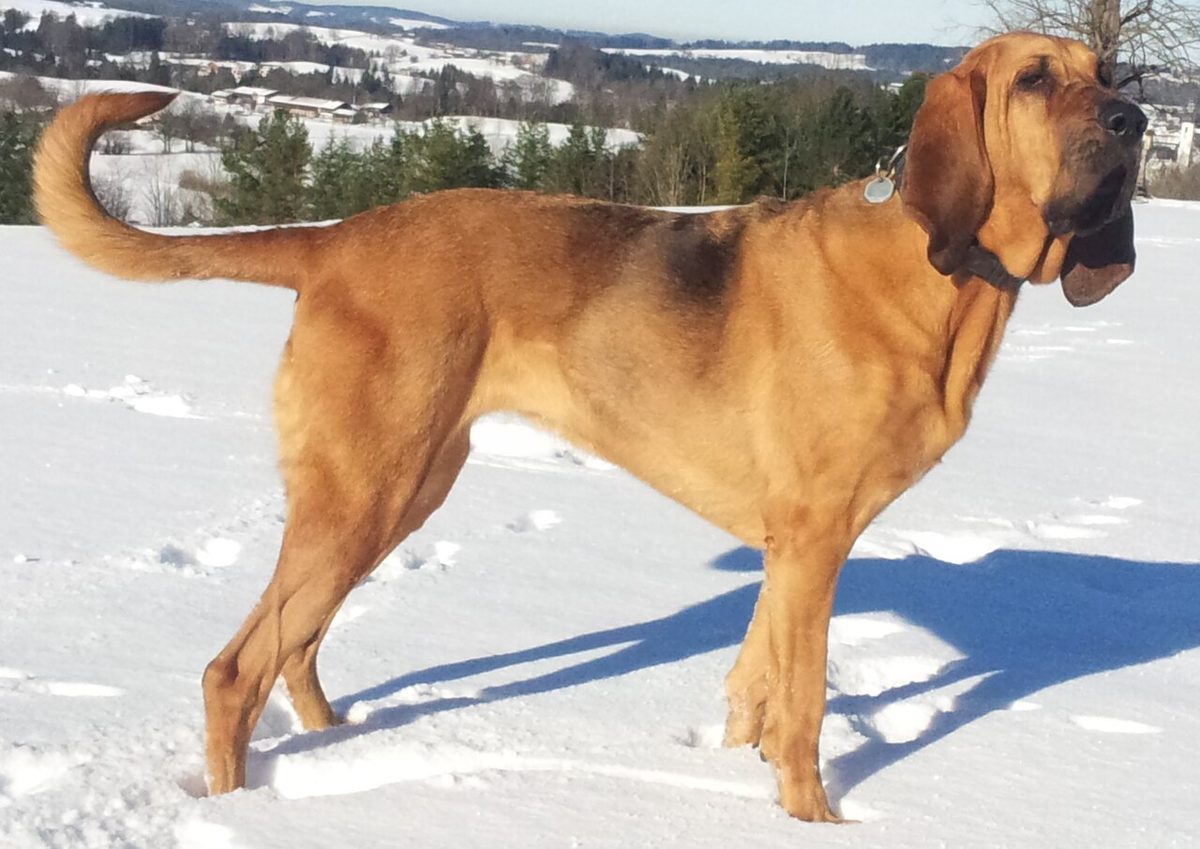
The Bloodhound is a large scenthound, first bred to hunt deer, wild boar and rabbits and used since the Middle Ages to track people. It is believed to descend from hounds once kept at the Abbey of Saint-Hubert in Belgium, and in French it is still called the chien de Saint-Hubert. Police forces around the world use Bloodhounds to follow the trail of fugitives, missing people and lost pets, often over long distances and long after the scent was laid.
History
According to legend, the St. Hubert Hound was first bred around the year 1000 by monks at the Saint-Hubert monastery, though its likely origins are in France. From about 1200 the monks sent several pairs of black hounds to the King of France each year. Opinions of them at court varied: Charles IX thought them slow, and 16th-century writers judged them useful mainly as leash hounds. The gifts stopped with the French Revolution, and writers generally agree that the original St. Hubert strain died out in the 19th century. The St. Hubert of continental Europe today owes its existence to the Bloodhound.
In England, Bloodhounds appear in writing from the early to middle 14th century, already well established. It is often said that William the Conqueror brought their ancestors from Normandy, but there is no evidence for this. Medieval hunters used the Bloodhound as a limer, a hound worked on a leash to find a stag or boar by its cold scent before the pack was released. Stories from medieval Scotland tell of Robert the Bruce and William Wallace being followed by sleuth hounds, and in the 16th century John Caius described the Bloodhound tracking thieves, poachers and cross-border raiders by their foot scent. He also explained the name, from the hound’s use in following the scent of blood.
Appearance
Bloodhounds stand 58 to 72 cm at the withers, and males weigh 46 to 54 kg, females 40 to 48 kg. They have an unusually heavy skeleton, with very thick bones for their length, and the hanging ears and lips that Caius noted centuries ago. The coat is short and hard.
Until at least the 17th century Bloodhounds came in all colors. Today they are black and tan, liver and tan, or red. Dark pigment may be limited to a saddle or cover most of the body like a blanket, while red hounds have no saddle at all. A little white on the chest, and sometimes the feet, is not unusual.
Temperament
The Bloodhound is gentle, affectionate and even-tempered with people, and is considered a good family dog. It is tireless on a trail. That same tracking drive can make it willful, and it is not the easiest dog to train in obedience or to handle on a leash.
Care and health
Bloodhounds have an unusually high rate of stomach and gut problems. Bloat (gastric dilatation volvulus) is the most common illness and the leading cause of death; in a 2004 Kennel Club survey it accounted for 34 percent of deaths, with cancer second at 27 percent. Eye, skin and ear troubles are also common, and the breed overheats quickly. A 2024 UK study found a life expectancy of 9.3 years.
Facts on this page were checked against Wikipedia and may have changed since.