Bouvier des Ardennes
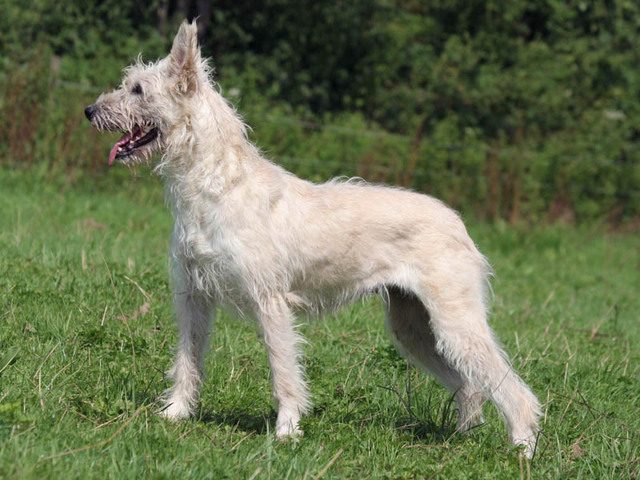

- Origin
- Belgium
- Type
- Herding
- Size
- Medium
- Height
- 52–62 cm (20–24 in)
- Weight
- 22–35 kg (49–77 lb)
- Coat
- Rough, wiry double coat with a beard and mustache
- Colors
- Any color except white
- Status
- Rare; recognised by the FCI
The Bouvier des Ardennes is a rare Belgian breed from the Ardennes region. It was a drover’s dog, used above all to herd and guard cattle.
History
Herding dogs have worked in the Belgian Ardennes since at least the 19th century. The climate there is harsh and the ground difficult, and only the toughest and hardest-working dogs were kept to drive cows, sheep, pigs and horses. By the end of that century these dogs looked like sheepdogs but were bigger, stronger and more aggressive.
Belgian dog shows opened classes for drovers’ dogs in order to settle their type, and a breed standard was published in 1923. The Bouvier des Ardennes itself was established after 1910 as a dog of intermediate size, by crossing the Bouvier des Flandres with the Belgian Malinois and perhaps the Briard. During the World Wars the dogs were used by poachers.
In the 20th century farms in the Ardennes disappeared and dairy herds shrank, and the number of working dogs fell with them. The breed was believed to be extinct until a small population was found in 1985. Breeders then set about rebuilding it, using the original standard as their guide.
Appearance
This is a sturdy, medium-sized dog built for work, not elegance. It is short, compact and well muscled, with heavier bone than its size suggests and a powerful head. The ears are set high.
The coat is rough and wiry, of medium length, with a mustache, a small beard and eyebrows that give the dog a stern look. Any color except white is allowed; brindled and peppered coats are the most usual.
The standard gives males as 56–62 cm (22–24 in) tall and 28–35 kg (62–77 lb), and females as 52–56 cm (20–22 in) and 22–28 kg (49–62 lb).
Some dogs are born with short tails and others with long ones. Tails have traditionally been docked; ears are not cropped. In the show ring the breed is judged standing naturally, without being posed or touched by its handler.
Care and health
Because the breed came so close to dying out and its population is still small, it is highly inbred and has limited genetic diversity.
Facts on this page were checked against Wikipedia and may have changed since.