Alaskan Klee Kai

- Origin
- United States
- Type
- Spitz
- Size
- Small
- Height
- Up to 43 cm (17 in)
- Weight
- 2.3–10 kg (5–22 lb)
- Coat
- Standard or full-coated
- Colors
- Black and white, gray and white, or red and white
- Status
- Recognised by the UKC and AKC
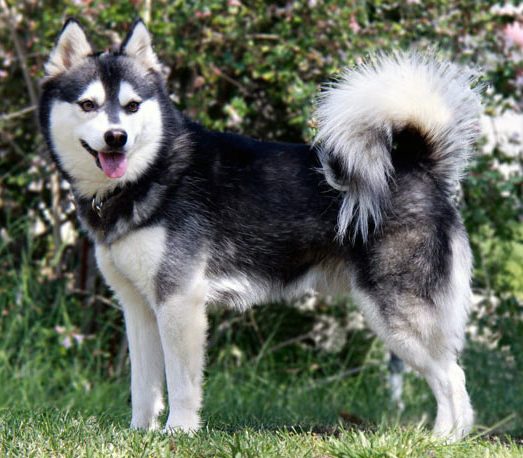
The Alaskan Klee Kai is a small spitz-type dog from the United States. It was developed in the late 20th century as a companion-sized dog that looks like the much larger Alaskan Malamute and Siberian Husky, and it is bred in three sizes: toy, miniature and standard.
History
The breed was developed in Alaska in the 1970s by Linda Spurlin. She built it from the Alaskan Husky, with a small amount of Siberian Husky, a slightly larger share of American Eskimo Dog, and some Schipperke. Spurlin bred selectively, keeping only the best dogs in her program. The name Klee Kai comes from Athabaskan words meaning “little dog”.
Appearance
The Klee Kai looks like a northern sled dog in miniature. Toy dogs stand up to 33 cm (13 in) and weigh under 4.5 kg (10 lb). Miniatures stand 33–38 cm (13–15 in) and weigh about 4.5–6.8 kg (10–15 lb). Standards stand 38–43 cm (15–17 in) and weigh roughly 6.8–9 kg (15–20 lb); a dog slightly over 43 cm still counts as a standard, but the extra height is a fault. The first club standard of 1993 gave weight ranges, while later versions ask only that weight be in proportion to height.
The coat comes in shades of three color combinations: black and white, gray and white, and red and white. Under the breed standard, a solid-colored dog may be kept out of the show ring and out of breeding programs.
Temperament
The Klee Kai is curious, agile, intelligent and somewhat aloof. Its cleverness can tip over into stubbornness, which breeders regard as an unwanted trait. It is an energetic dog and does well in agility: although small, it is thick-boned and can manage high jumps, and its size lets it move through a course easily.
Care and health
The breed is believed to be fairly healthy, but it is young, and there may not yet have been enough time to know how common inherited diseases are. Conditions reported in the Klee Kai include juvenile cataracts, liver disease, factor VII deficiency, heart problems and thyroid problems.
Facts on this page were checked against Wikipedia and may have changed since.