Akita Inu
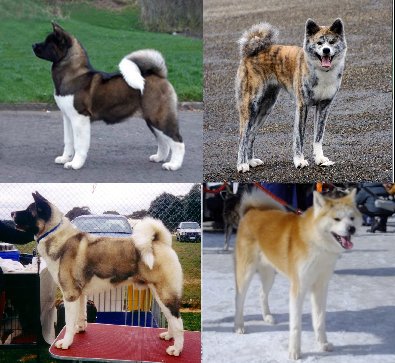

- Origin
- Japan
- Type
- Spitz
- Size
- Large
- Height
- 58–71 cm (23–28 in)
- Weight
- 25–59 kg (55–130 lb)
- Coat
- Thick double coat
- Colors
- Red, fawn, sesame, brindle or white, with whitish fur on the underside
- Life span
- About 11 years
- Status
- Recognised by the FCI, AKC, UKC and The Kennel Club
The Akita Inu is a large working dog from the mountains of northern Japan, with the thick double coat of a northern spitz. Its roots lie in the dogs of the Matagi, the traditional hunters of the Tōhoku region, who used them to track and hold bear, wild boar and serow in the snow. Today it is mainly a companion.
History
The Akita’s direct ancestor was a guard and fighting dog kept by samurai and wealthy farmers around the town of Ōdate. It was called the Ōdate dog until 1931, when it was renamed the Akita Inu and declared a Japanese natural monument. The mayor of Ōdate had founded a preservation society, the Akita Inu Hozonkai, in 1927.
During the Second World War the government ordered non-military dogs culled, and Akitas were crossed with German Shepherds to save them. After the war, breeders such as Morie Sawataishi gathered the survivors and rebuilt the breed.
The story of Hachikō carried the breed’s name abroad. Born in 1923, he met his owner, Professor Ueno, at Shibuya station in Tokyo every day. After the professor died at work in 1925, the dog kept returning to the station for nine years.
Helen Keller was given the first two Akitas to enter the United States after visiting Japan in 1937, and American servicemen brought more home after the war. American breeders kept types that fell out of favor in Japan, and the two lines drew apart. The American Akita is larger and heavier in the bone, with a bear-like head, and comes in any color. The Fédération Cynologique Internationale split them into two breeds in 1999, and the American Kennel Club, the United Kennel Club and The Kennel Club also treat them as separate.
Appearance
The Akita is a substantial dog for its height. The head is large, with erect triangular ears tilted forward and small, dark, deep-set eyes. The tail curls over the back. Akitas stand 58 to 71 cm (23 to 28 in) and weigh 25 to 59 kg (55 to 130 lb), with the Japanese type toward the smaller, lighter end and finer in the head.
Japanese Akitas may only be red, fawn, sesame, brindle or pure white. All have urajiro, whitish fur on the muzzle, cheeks, chest, belly, the underside of the tail and the inside of the legs. A black mask or pinto marking is a disqualification.
Temperament
The Akita is a strong, independent and dominant dog. It is territorial about its home and can be reserved with strangers, though a well-trained Akita accepts visitors who pose no threat. In a Polish survey of five old breeds, Akitas were the most likely to be aggressive toward other dogs.
Care and health
Akitas are generally hardy. A British study found a life expectancy of 11.4 years, somewhat below the average for purebred dogs.
Several autoimmune diseases occur in the breed, among them uveo-dermatologic syndrome, sebaceous adenitis, pemphigus foliaceus, autoimmune hemolytic anemia and lupus. Other conditions on record include bloat, hip and elbow dysplasia, glaucoma and progressive retinal atrophy.
Facts on this page were checked against Wikipedia and may have changed since.