Carolina Dog

- Origin
- United States
- Type
- Primitive
- Size
- Medium
- Height
- 46–61 cm (18–24 in)
- Weight
- 16–23 kg (35–50 lb)
- Coat
- Short and smooth
- Colors
- Reddish ginger, buff, fawn, black and tan, or piebald, often with white markings
- Status
- Recognised by the UKC; in the AKC Foundation Stock Service
The Carolina Dog is a medium-sized dog that began as a landrace in the southeastern United States, where it is still occasionally found living wild in remote stretches of longleaf pine and cypress swamp. Breeders have since worked to establish it as a standardized breed. Despite the name, it is not the state dog of either North or South Carolina.
History
American writers were describing the “Indian dogs” of North America in the 1920s. In 1920 Glover Morrill Allen proposed that they descended from primitive dogs of Asia, and pointed to dog skeletons excavated from Native American mounds in Florida, Georgia and South Carolina. Those dogs had been buried whole and apart from people, which showed they had not been eaten.
The free-roaming dogs were brought to wider notice by I. Lehr Brisbin Jr., a research ecologist at the University of Georgia’s Savannah River Ecology Laboratory. He came across them at the Savannah River Site, an area closed to the public from 1950.
The United Kennel Club has registered Carolina Dogs since 1996, in its Sighthound and Pariah Group, and the American Rare Breed Association has also issued a standard. In July 2017 the American Kennel Club took the breed into its Foundation Stock Service, the first step toward full recognition, and lists it with the hounds.
Genetic studies give a mixed picture. A 2013 study of mitochondrial DNA found that 37% of the Carolina Dogs sampled carried a previously unknown type belonging to a group that arose in East Asia, and found no recent maternal link to the Australian dingo or the New Guinea singing dog. A 2015 study estimated 10% to 35% pre-Columbian ancestry in the breed’s maternal lines. A 2020 study of nuclear DNA concluded that its makeup was best explained as about 62% European.
Appearance
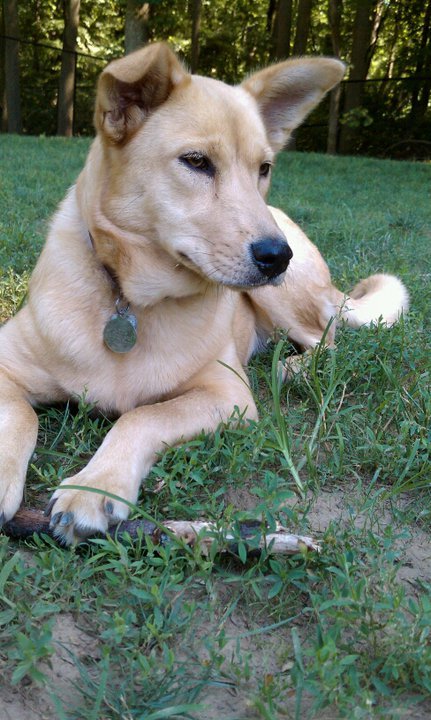
Carolina Dogs stand 46 to 61 cm (18 to 24 in) tall and weigh 16 to 23 kg (35 to 50 lb). Build runs from slender and graceful to rather stockier, but always strong and athletic, with a firm, narrow waist and fairly large paws.
The ears are the breed’s hallmark: upright, very long and tapering to fine points, and able to turn separately toward a sound. The tail is usually carried upturned and often has a hook at the end. The coat is typically short and smooth, as suits a warm climate.
Colors include reddish ginger, buff, fawn, black and tan, and piebald, with or without white on the toes, chest, tail tip and muzzle. The almond-shaped eyes are set at a slant and are usually dark brown or orange, often rimmed in black like eyeliner. Puppies frequently have a dark mask that fades as the adult coat comes in.
Behavior
Females have three heat cycles in quick succession, which later settle into a seasonal pattern. This is thought to let dogs living wild breed quickly, before diseases such as heartworm take their toll.
Facts on this page were checked against Wikipedia and may have changed since.