Fila Brasileiro

- Origin
- Brazil
- Type
- Mastiff
- Size
- Giant
- Height
- 60–75 cm (24–30 in)
- Weight
- At least 40–50 kg (88–110 lb)
- Coat
- Short, dense, smooth and soft
- Colors
- Brindle, fawn or black
- Status
- Recognised by the FCI
The Fila Brasileiro is a large working dog of the mastiff type from Brazil. It is used as a guard, for herding cattle and for hunting big game, and some are kept as companions. The name comes from the Portuguese verb filar, to hold or grab: a fila dog is a catch dog, one that bites and does not let go.
History
The Fila is thought to descend from European dogs brought to Brazil in colonial times, with little or no contribution from the native dogs of South America. It was bred and raised mainly on the big plantations and cattle farms. There the dogs were taught to pursue cattle, jaguars and other animals, and also, while slavery was legal in Brazil, people who had escaped it.
The first written standard dates from 1946. Breeders in São Paulo organized a planned breeding program and opened a stud book. Paulo Santos Cruz, regarded as the father of the breed, began breeding Filas systematically and wrote the first standard.
Three clubs in Brazil now keep three different standards. The one used by the Confederação Brasileira de Cinofilia, which is affiliated with the FCI, is the best known internationally. Those of the clubs CAFIB and AMFIBRA are based on Santos Cruz’s original and aim to preserve the older type. The split followed accusations that dogs registered with the national kennel club from the 1970s to the 1990s had been crossed with foreign breeds.
Appearance
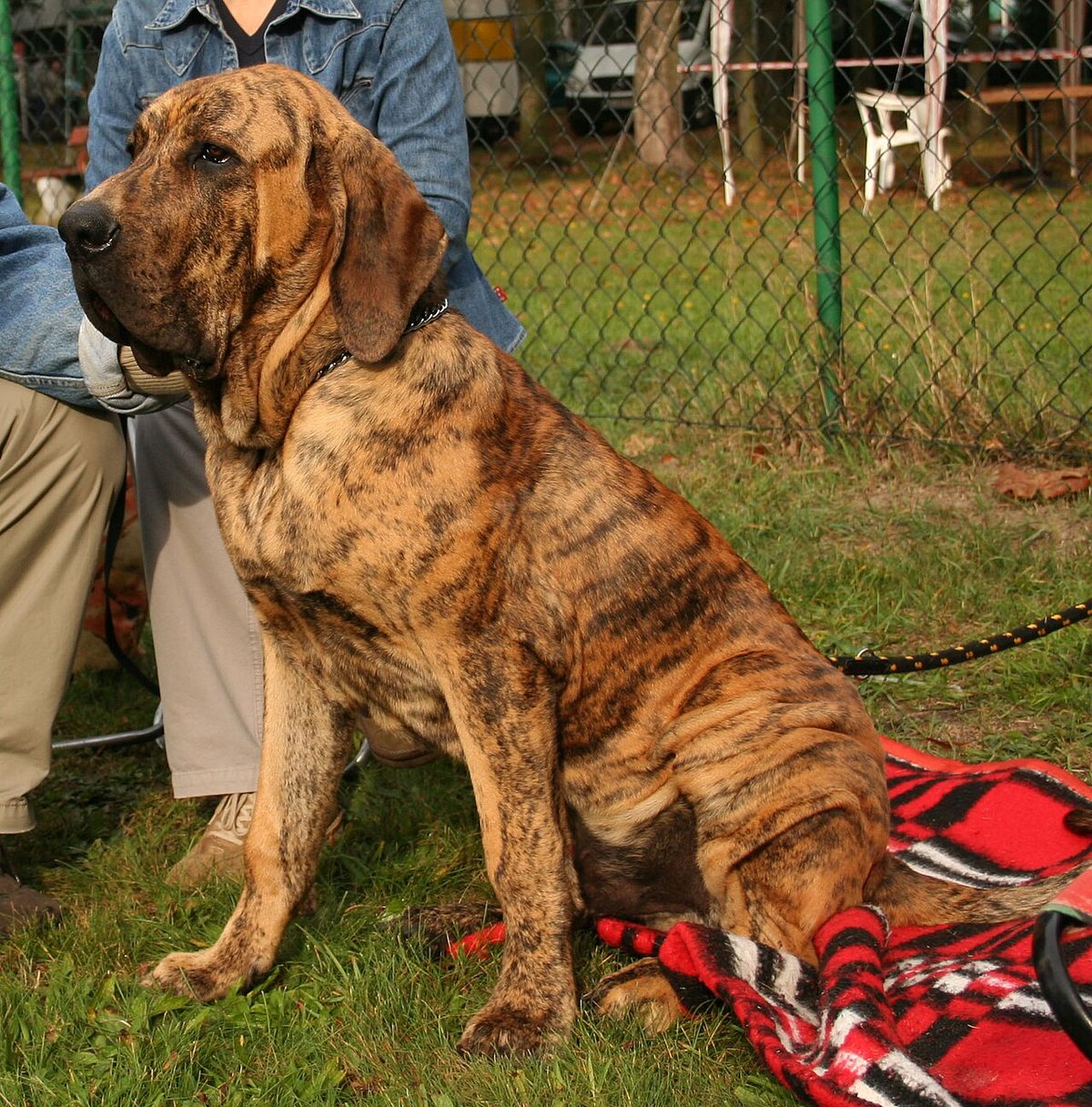
At first glance the Fila resembles a Bloodhound, with its hanging ears, loose neck skin and often sandy coat, but it is stronger, stockier, taller and heavier in bone. Under the international standard, males stand 65–75 cm (26–30 in) at the withers and weigh at least 50 kg (110 lb). Females stand 60–70 cm (24–28 in) and weigh at least 40 kg (88 lb).
The body is rectangular and massive, yet the dog is clearly agile. The head is big and heavy with a deep muzzle, and the ears are large, thick and tapered. The chest is broad and deep, the legs heavily boned, and, unusually for a dog, the croup stands higher than the withers.
The skin is the breed’s hallmark. It is thick and loose all over, especially at the neck, where it forms dewlaps that in many dogs run on down to the chest and belly.
The coat is short, dense, smooth and soft. The international standard allows black, fawn and brindle, sometimes with a black mask, and white on the feet, chest and tail tip covering no more than a quarter of the dog. It does not allow mouse-gray, black-and-tan, blue, dappled or solid white. The CAFIB standard also rejects black, which it treats as a sign of crossbreeding, but accepts larger white markings.
Legal status
Owning a Fila Brasileiro without a court exemption is illegal in the United Kingdom, Norway, Australia, Fiji, Hong Kong and Cyprus. Turkey bans owning and breeding it, and Trinidad and Tobago classes it as a dangerous dog, which bars imports and requires males to be neutered.
Facts on this page were checked against Wikipedia and may have changed since.