English Mastiff
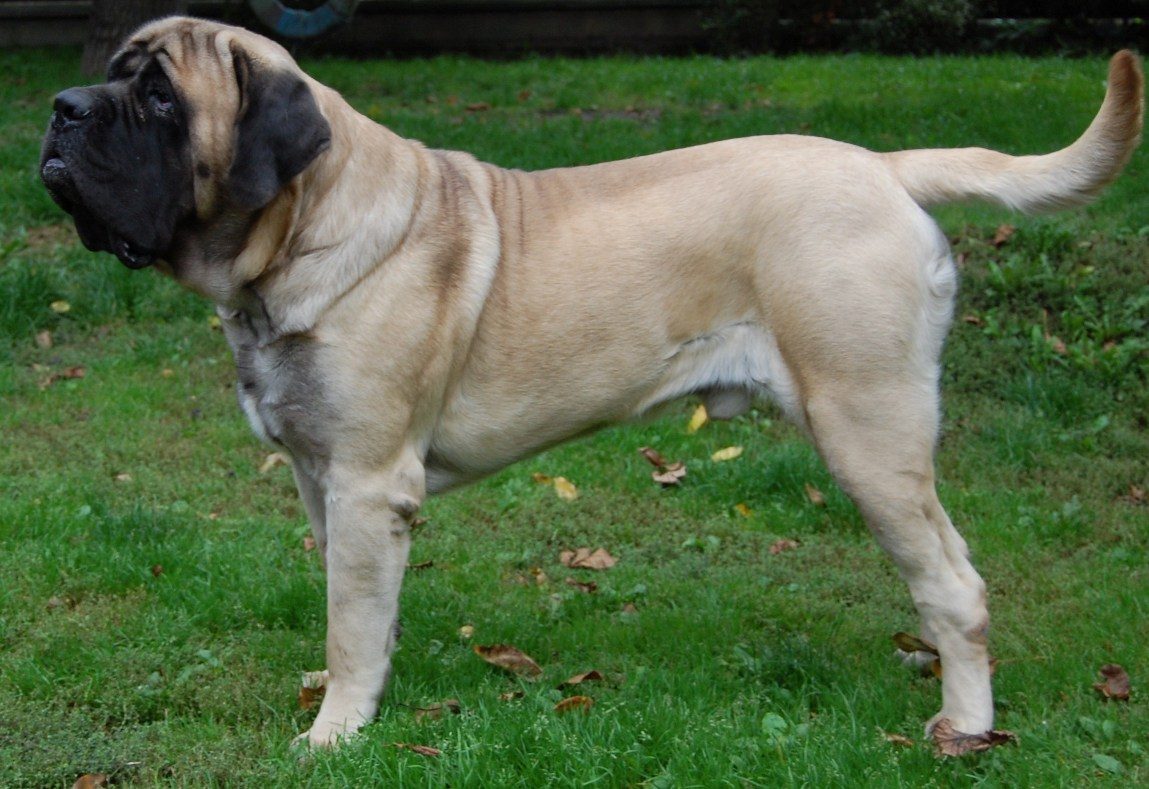

- Origin
- England
- Type
- Mastiff
- Size
- Giant
- Height
- 70–77 cm (28–30 in)
- Weight
- 80–85 kg (176–187 lb)
- Coat
- Short, fine and smooth
- Colors
- Apricot, fawn or brindle, always with a black mask
- Life span
- About 9 years
- Status
- Recognised by the FCI, AKC and The Kennel Club
The English Mastiff, or simply the Mastiff, is a very large British dog and the heaviest of all breeds. It has a massive body, a broad head, a short coat and always a black mask. For centuries dogs of this type guarded houses and estates and were used in hunting and in blood sports; today the Mastiff is known for its gentle nature.
History
The breed probably descends from the Pugnax Britanniae, the British dogs of Roman times, and from the Alaunt, brought over by the Normans. The name “Mastiff” appears in the first English list of dog breeds, in The Book of Saint Albans, in the 15th century. From Roman to medieval times mastiff-type dogs were used for bull-, bear- and lion-baiting, dog fighting, hunting and guarding.
Baiting was banned in 1835, but Mastiffs went on guarding estates and businesses. Systematic breeding began in the 19th century with J. W. Thompson and T. V. H. Lukey, who used Alpine Mastiff blood. After 1850 the two worked together, and the modern Mastiff took shape; the type was fixed in the 1880s. The American Kennel Club recognized the breed in 1885.
The two world wars nearly ended it. By 1918 it had all but vanished outside Britain, and meat rationing halted almost all British breeding during the Second World War. Only one bitch puppy from the surviving British stock, Nydia of Frithend, grew to maturity. The breed was rebuilt from her and from some fourteen dogs in North America, with imports returning to Britain after the war. It is now found worldwide, but The Kennel Club still classes it as vulnerable in its home country, where only 104 births were registered in 2020.
Appearance
The Mastiff is heavier on average than the Saint Bernard, and far more robust than taller breeds such as the Irish Wolfhound and the Great Dane. The body is deep and broad, with the forelegs set wide apart, and is longer than it is tall. The standards set no height or weight; dogs are usually about 70–77 cm and 80–85 kg.
The coat is short and close-lying. It is fawn or apricot, or brindle on one of those colors, always with black on the muzzle, ears and nose and around the eyes. Long-coated dogs, called “Fluffies”, turn up now and then, and piebald dogs are rare.
Temperament
Kennel standards and old descriptions agree on the Mastiff’s character. The American Kennel Club describes it as combining grandeur and good nature with courage and docility. It is a powerful but gentle and loyal dog. Because of its size and need for room it is best suited to life in the country or the suburbs.
Care and health
A UK study found a life expectancy of 9 years. The main health problems are hip dysplasia and gastric torsion. Obesity, osteosarcoma and cystinuria also occur, and less often cardiomyopathy, allergies, cruciate ligament rupture, hypothyroidism, osteochondritis dissecans, entropion, progressive retinal atrophy and persistent pupillary membranes.
Facts on this page were checked against Wikipedia and may have changed since.