Leonberger
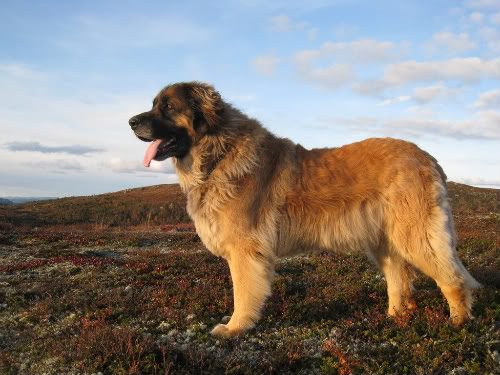

- Origin
- Germany
- Type
- Working
- Size
- Giant
- Height
- 65–80 cm (26–31 in)
- Weight
- 45–77 kg (100–170 lb)
- Coat
- Long, dense, water-resistant double coat with a mane on the neck and chest
- Colors
- Lion yellow, red, reddish brown or sandy, with a black mask
- Life span
- About 8–10 years
- Status
- Recognised by the FCI and AKC
The Leonberger is a very large German dog named after the town of Leonberg in Baden-Württemberg, where it was bred in the mid-19th century. Traditionally it was a farm dog, praised as a watchdog and for pulling carts, and it is also a strong swimmer used in water rescue.
History
Heinrich Essig, a dog breeder and seller who was mayor of Leonberg, said he created the breed in the 1830s by crossing a Landseer Newfoundland female with a male from the Great St Bernard Hospice, and later adding a Pyrenean Mountain Dog. The first dogs registered as Leonbergers were born in 1846. Essig’s account is disputed: records from 1585 and 1601 may describe similar dogs, and critics of his day called his dogs a poor copy of the St. Bernard. There is no doubt, though, that he was the first to name and register the breed.
The two world wars nearly wiped the Leonberger out. The dogs were used to pull ammunition carts, only five survived World War I, and after World War II just eight remained, from which today’s dogs descend. The darker coat and black mask of the modern dog came later in the 20th century, when other breeds such as the Newfoundland were brought back in. The American Kennel Club recognised the Leonberger in its Working Group on January 1, 2010.
Appearance
The Leonberger is large, muscular and elegant, and males and females are easy to tell apart. Males stand 71 to 80 cm (28 to 31 in) at the withers and weigh 54 to 77 kg (120 to 170 lb); females stand 65 to 75 cm (26 to 30 in) and weigh 45 to 61 kg (100 to 135 lb).
The head is deeper than it is broad, with dark brown almond-shaped eyes and medium-sized ears that hang close to the skull. The paws are webbed. The double coat is long, dense and water-resistant, fairly straight on the body and shorter on the muzzle and legs. Mature males carry a marked mane, and the tail is well feathered. Colors are lion yellow, red, red-brown and sand, in any combination, always with a black mask, nose, lips and pads.
Temperament
The Leonberger is above all a family dog. Well socialized and trained, it is self-assured, unbothered by noise, friendly with children, calm with passersby and steady when protecting its home. It is loyal, intelligent and playful, and adapts easily to new situations and to other dogs. Because of its size, good control and early training are essential.
Care and health
The coat is shown untrimmed apart from tidying the feet. Leonbergers are poorly suited to hot climates.
Lifespan is short. A 2024 UK study found a life expectancy of 10 years and a 2015 French study 8.75 years. The breed descends from few founders and is highly inbred. Cancer is common, with a predisposition to hemangiosarcoma and osteosarcoma. Other conditions recorded include arthritis, hip dysplasia, hereditary polyneuropathy, hypothyroidism, gastric torsion, dilated cardiomyopathy and cataracts.
Facts on this page were checked against Wikipedia and may have changed since.