Dog breedsPinscher and schnauzer
Standard Schnauzer

- Origin
- Germany
- Type
- Pinscher and schnauzer
- Size
- Medium
- Height
- 45–50 cm (18–20 in)
- Weight
- 14–20 kg (31–44 lb)
- Coat
- Hard, wiry and dense, with a soft undercoat
- Colors
- Pepper-and-salt or black
- Life span
- About 13 years
- Status
- Recognised by the FCI; endangered in Germany
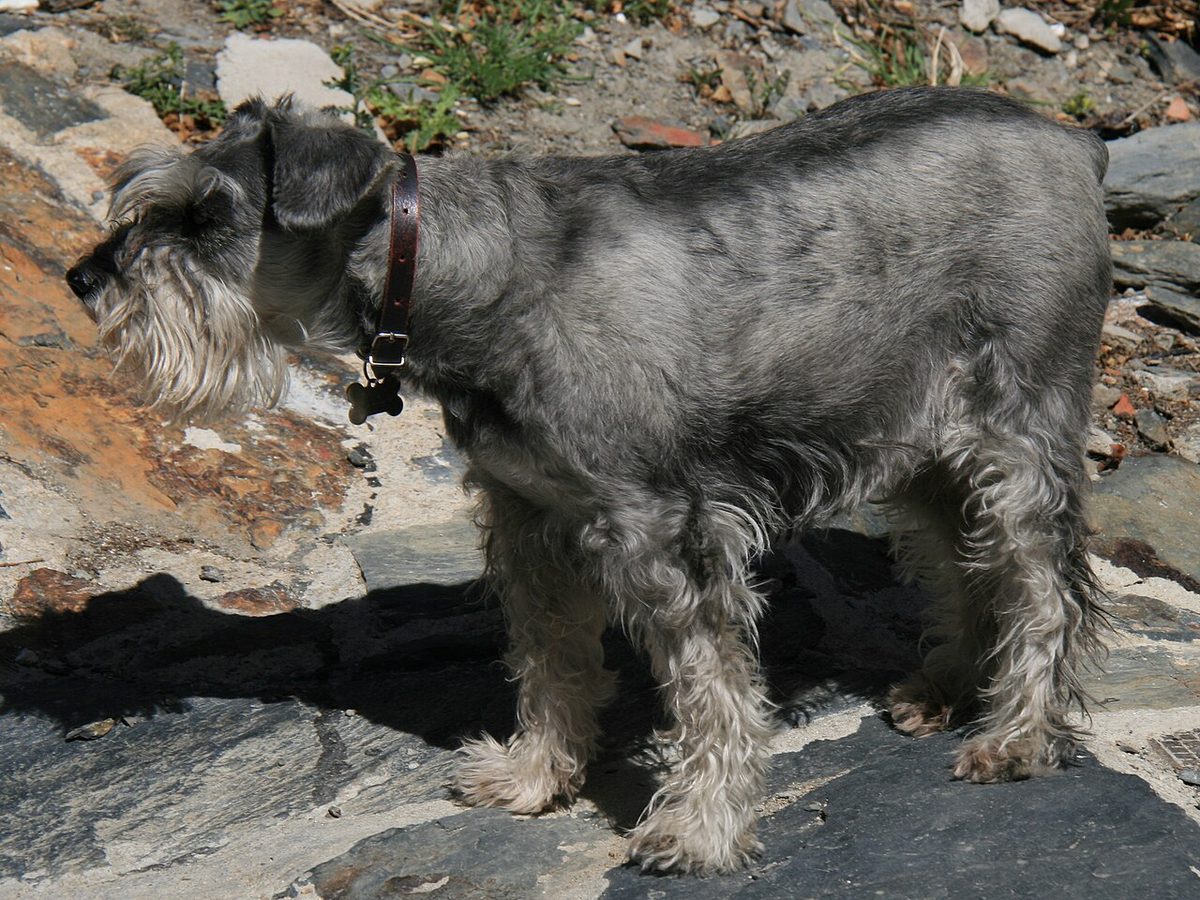
The Standard Schnauzer, or Mittelschnauzer, is a medium-sized German dog with a wiry coat and a thick, bristly beard and whiskers, usually paler than the body. It is the middle one of three Schnauzer breeds, between the Giant and the Miniature. It was traditionally a farm dog with a talent for catching rats, and today it is mostly a companion.
History
The Schnauzer comes from southern Germany and shares its early history with the German Pinscher. Both rough-haired and smooth-haired dogs of this kind were kept as carriage and stable dogs and were good ratters. Both were called Deutscher Pinscher, came from the same lines, and could be born in the same litter. The rough-haired type, the future Schnauzer, was also known as the Rattler.
Nobody knows where the name came from or when it was first used. In German, Schnauze means snout, and Schnauz or Schnauzbart a walrus moustache. “Schnauz” was a common dog’s name, and at a show in Hanover in 1879 a dog called Schnautzer won the Wire-haired Pinscher class.
The Pinscher entered the German stud book in 1880, when the first standard was written. A club for both coat types, the Pinscherklub, was founded in 1895, and Mittelschnauzer breeders formed their own club in Munich in 1907. In 1917 the rough-haired breed was officially renamed from Rauhaarige Pinscher to Schnauzer. The two clubs merged in 1918 into what is now the Pinscher-Schnauzer-Klub. The Fédération Cynologique Internationale accepted the breed definitively in 1955.
A few Schnauzers reached the United States before the First World War. The Wire-Haired Pinscher Club of America started in 1925 and in 1933 split in two, one half becoming the Standard Schnauzer Club of America. A Standard Schnauzer was Best in Show at Westminster in 1997.
Between the wars the pepper-and-salt color thrived and black was less common; after 1945 it was the other way round. The pepper-and-salt Schnauzer has been on the red list of Germany’s society for old and endangered livestock breeds since 2014 and was rated endangered in 2022. German registrations for the breed averaged 464 a year from 2007 to 2021.
Appearance
The Schnauzer is robust and square in build. Dogs and bitches alike usually stand 45 to 50 cm at the withers. Weight is given as 14 to 20 kg or as 15 to 24 kg, depending on the source. The coat is hard, wiry and dense over a thick, soft undercoat, and is either black or pepper-and-salt. In the pepper-and-salt the gray runs from pale silver to dark iron gray, always with a darker mask. The V-shaped ears are set high and hang close to the face. The eyes are dark and the nose and lips black.
Care and health
Median lifespan is reported as 13 years, slightly longer than the 12.5 years for dogs overall.
Facts on this page were checked against Wikipedia and may have changed since.