Dog breedsPinscher and schnauzer
Miniature Schnauzer
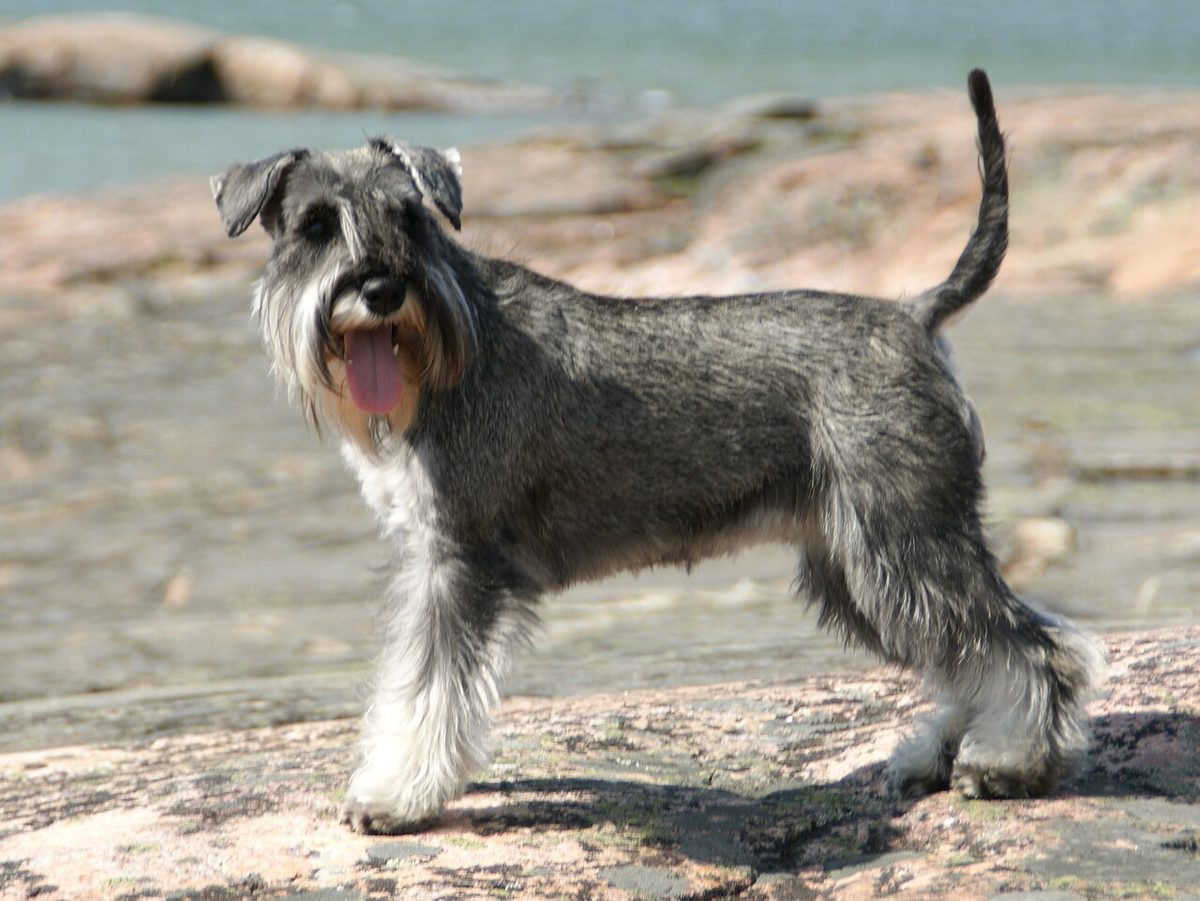

- Origin
- Germany
- Type
- Pinscher and schnauzer
- Size
- Small
- Height
- 30–35 cm (12–14 in)
- Weight
- 4–8 kg (9–18 lb)
- Coat
- Dense, wiry and harsh, with a dense undercoat
- Colors
- Solid black, black and silver, salt and pepper, or white
- Life span
- About 13 years
- Status
- Recognised by the FCI and AKC
The Miniature Schnauzer is the smallest of the three Schnauzer breeds and the most popular. It arose in Germany in the late nineteenth century, when farmers wanted a small, efficient ratting dog. It may have been bred down from the smallest Standard Schnauzers, or from crosses between the Standard and smaller breeds such as the Affenpinscher, the Miniature Pinscher and Poodles.
History
The Schnauzers come from southern Germany and share their history with the German and Miniature Pinschers. Rough-haired and smooth-haired dogs of this family, in several sizes, were kept as carriage and stable dogs and were good ratters. Both kinds were called Pinscher, and both could be born in one litter. The rough-haired type was also known as the Rattler.
The Pinscher was entered in the German stud-book in 1880, when the first standard was written. An illustration of 1888 already shows a miniature rough-haired Pinscher beside the standard size. A breed society, the Pinscherklub, was founded in 1895, and in 1917 the rough-haired breed was officially renamed the Schnauzer. The German word Schnauze means “snout”, and Schnauzbart a walrus mustache.
A few Miniature Schnauzers went to the United States in 1924. A club for Standards and Miniatures together was started there in 1925 and split in 1933, one half becoming the American Miniature Schnauzer Club. The Fédération Cynologique Internationale gave the breed full acceptance in 1955. In the federation’s 2013 census it was the tenth most registered breed in the world.
Appearance
Under the international standard both sexes stand 30 to 35 cm at the withers and weigh 4 to 8 kg, most often 4.5 to 7 kg. Seen from the side the dog is roughly square.
The head is rectangular, with a bushy beard, mustache and eyebrows, dark oval eyes and V-shaped ears that fold forward when left natural. The front legs are very straight, and the feet short and round with thick black pads. The tail is naturally thin and short.
The coat is double, wiry outside and soft beneath. For the show ring it is kept short on the body and left longer on the legs, belly and face. The four recognised colors are black, salt and pepper, black and silver, and white. In a salt and pepper coat each hair is banded in black, gray and silver, fading to gray or silver on the eyebrows, whiskers, underside and legs. White is accepted by the international federation but not for showing by the American or Canadian kennel clubs.
Temperament
The American standard describes the breed as alert and spirited yet obedient, friendly, intelligent and willing to please, and never overaggressive or timid. Miniature Schnauzers are usually easy to train and make excellent watchdogs, more inclined to bark than to bite. They tend to be aloof with strangers until their owners welcome the guest, and friendly afterward.
Although North American clubs place the breed in the Terrier Group because of its rat-catching past, it has no shared ancestry with British terriers and is more laid-back, obedient and tolerant of other dogs than they are.
Care and health
A British study found a life expectancy of 13.3 years, and a Japanese study 13.4 years.
The breed is predisposed to gall bladder mucoceles, congenital portosystemic shunts and atopic dermatitis, and is prone to von Willebrand disease, an inherited bleeding disorder. Schnauzer comedo syndrome, found only in this breed, is an inherited defect of the hair follicles that produces small blackheads along the back and can lead to infection, hair loss and crusting.
Facts on this page were checked against Wikipedia and may have changed since.