Briard
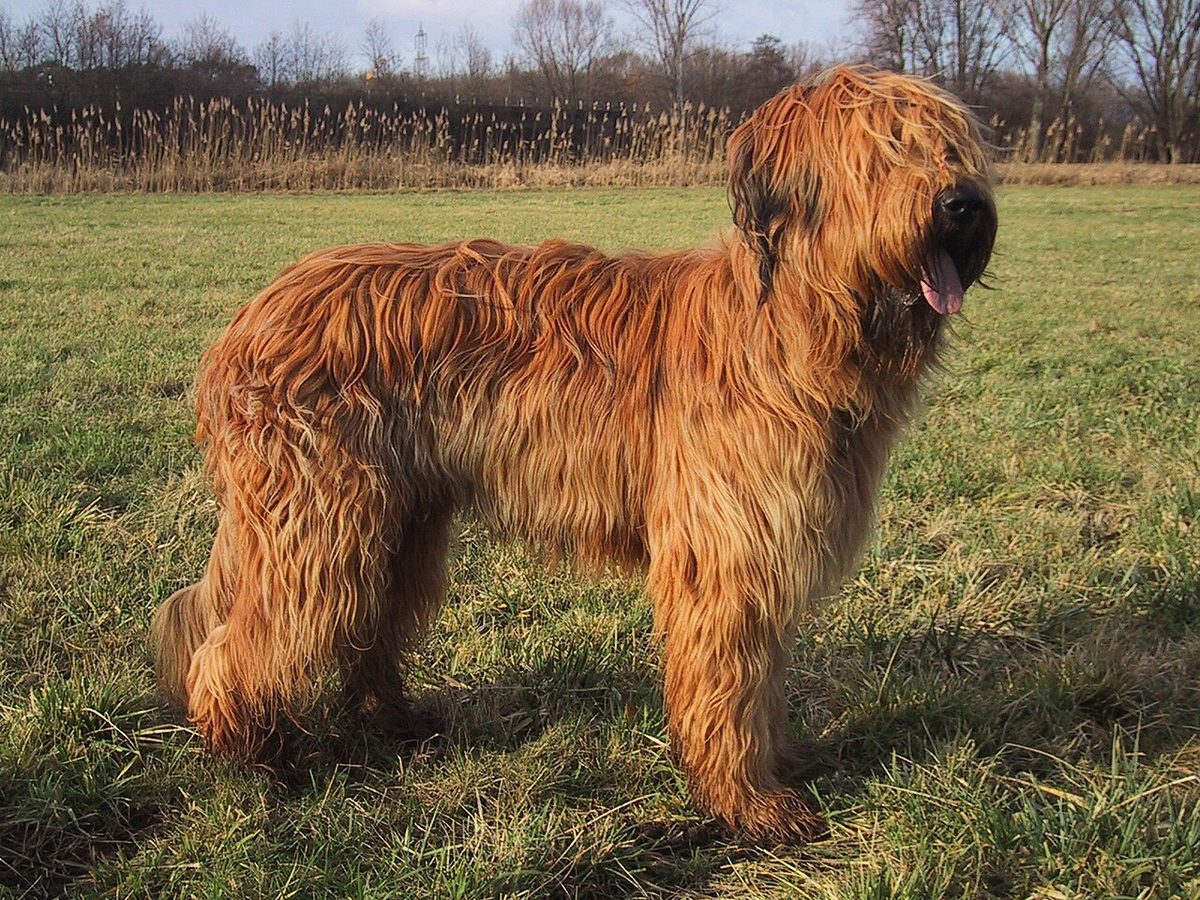

- Origin
- France
- Type
- Herding
- Size
- Large
- Height
- 56–68 cm (22–27 in)
- Coat
- Long, slightly wavy and harsh, like a goat's
- Colors
- Black, fawn, gray or blue; fawn overlaid with black
- Life span
- About 12.6 years
- Status
- Recognised by the FCI
The Briard, or Berger de Brie, is a large French shepherd dog. It comes from the historic Brie region of north-central France, where it was used both to herd sheep and to protect them.
History
The earliest written mention of the shepherd dogs of Brie is thought to date from 1783, when Jean-Baptiste François Rozier described the chien de Brie as long-haired and usually black. He noted that on the open plains wolves were little threat, so the dogs mostly herded, keeping sheep out of crops and vineyards. In 1895 Pierre Mégnin clearly separated the long-haired Briard from the short-haired dog of Beauce, the modern Beauceron.
The breed was first shown at the first Paris dog show in 1863. The first Briard entered in the French stud-book was Sans Gêne, a gold medal winner at the Paris show of 1885. A standard followed in 1897, describing a woolly-coated variety and a goat-coated one; the woolly type later disappeared. A breed society, Les Amis du Briard, was formed in 1909.
Numbers fell in the First World War, when any suitable dog was sent to the front, and fell sharply again during the occupation of France in the Second. The FCI gave the breed full recognition in 1954.
As farming was mechanized after the war, the Briard became mainly a companion dog. Registrations in France climbed from 317 in 1970 to a peak of 6,364 in 1986, then dropped steeply. Disputes led to the breed club’s expulsion from the national kennel club, and a new society, the Association du Berger de Brie, was recognized in 1989.
Appearance
Males stand about 62 to 68 cm at the withers and females about 56 to 64 cm. The coat is at least 7 cm long, thick and harsh like a goat’s. It may be solid black, gray, blue or fawn, or fawn overlaid with black, and some graying is common.
An unusual feature is the double dewclaw on each hind leg. The standard treats a single or missing dewclaw as a disqualifying fault.
Care and health
Congenital hereditary retinal dystrophy has been identified in Briards in Sweden. In 2001, blindness caused by a related condition was partly reversed in three Briard puppies using gene therapy. A 2024 study found a median lifespan of 12.6 years, close to the average for all dogs.
Facts on this page were checked against Wikipedia and may have changed since.