Pomeranian

- Origin
- Pomerania
- Type
- Toy and companion
- Size
- Toy
- Height
- 20–36 cm (8–14 in)
- Weight
- 1.4–3.2 kg (3–7 lb)
- Coat
- Abundant and textured, with a neck ruff and plumed tail
- Colors
- Many; orange, black and cream or white are most common
- Life span
- 12–14 years
- Status
- Recognised by the AKC, and by the FCI as part of the German Spitz
The Pomeranian is a very small dog of spitz type, named after Pomerania, the region along the Baltic Sea in what is now northern Poland and Germany. It is classed as a toy breed. It descends from larger spitz dogs, the German Spitz in particular.
History
Pomerania is not where the spitz began, but it is credited with the breeding that produced the first dogs of Pomeranian type. Records are poor until the dogs reached Britain.
Two British queens shaped the breed. In 1767 Queen Charlotte, wife of George III, brought two Pomeranians to England. Named Phoebe and Mercury, they were painted by Thomas Gainsborough. The paintings show dogs much bigger than today’s, reportedly 14 to 23 kg (30 to 50 lb), but with the heavy coat, the ears and the tail curled over the back.
Her granddaughter Queen Victoria kept a large breeding kennel. One of her favorites was a small red sable dog, said to weigh only 5.4 kg (12 lb). When she first showed him in 1891, the small type became popular at once, and breeders began choosing only the smallest dogs. She also imported small Pomeranians of different colors from around Europe. During her lifetime the breed was reported to have halved in size.
The first breed club was founded in England in 1891, and a standard followed soon after. The American Kennel Club registered its first Pomeranian in 1898 and recognized the breed in 1900. The Fédération Cynologique Internationale includes it in its German Spitz standard.
Appearance
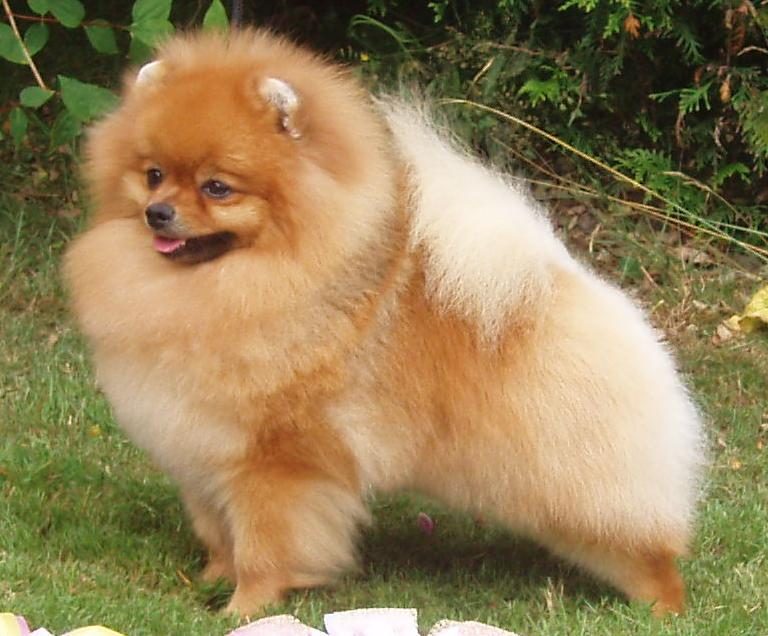
Pomeranians weigh 1.4 to 3.2 kg (3 to 7 lb) and stand 20 to 36 cm (8 to 14 in) at the withers. They are compact but sturdy. The coat is abundant and textured, with a ruff around the neck, a fringe of feathery hair on the hindquarters and a heavily plumed tail set high and carried flat over the back.
The earliest dogs were white, or sometimes brown or black. Red came into fashion at the end of the 19th century after Queen Victoria took on a small red dog. Today the breed comes in more colors than any other, among them white, black, brown, red, orange, cream, blue, sable, black and tan, brindle, parti-color and merle. Orange, black, and cream or white are the most common.
Temperament
Pomeranians are alert and quick to notice any change around them. Barking at anything new can turn into a habit of barking too much. They are somewhat defensive of their territory and may bark at noises outside.
Care and health
A British study found a life expectancy of 12.2 years, and a Japanese study 14 years.
The breed is prone to several conditions typical of toy dogs. Patellar luxation, in which the kneecap slips out of place, is common, as is a collapsed trachea, which causes a honking cough. Pomeranians are strongly predisposed to the coat disorder alopecia X. Other conditions recorded more often in the breed include atlantoaxial subluxation, congenital portosystemic shunt, gallbladder mucocele and, in males, cryptorchidism.
Litters are small, at around two or three puppies.
Facts on this page were checked against Wikipedia and may have changed since.