Australian Shepherd
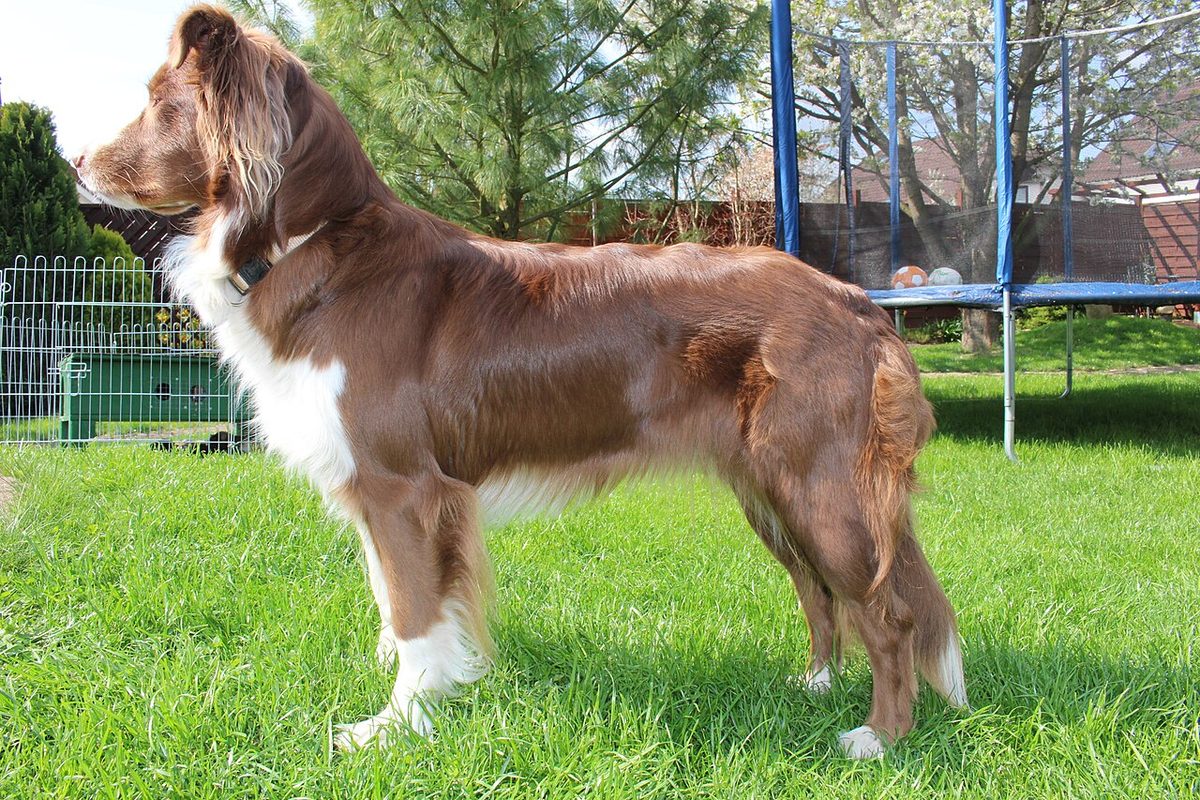

- Origin
- United States
- Type
- Herding
- Size
- Medium
- Height
- 46–58 cm (18–23 in)
- Weight
- 16–32 kg (35–70 lb)
- Coat
- Moderately long, wavy double coat
- Colors
- Blue merle, red merle, black or red, with or without white markings and tan points
- Life span
- About 13–14 years
- Status
- Recognised by the FCI, AKC and UKC
The Australian Shepherd, or Aussie, is a herding dog from the United States. Despite its name, it was developed in California in the 19th century to work sheep. It began as a ranch dog and nothing else, and has since become one of the most popular companion breeds in North America.
History
Part of the breed’s ancestry goes back to pastoral dogs brought to North America with Spanish flocks from the 1500s. These may have included the Carea Leonés, a mountain sheepdog that can show the merle coat and eye color seen in many Australian Shepherds. Other ancestors were herding dogs that arrived in California with imported sheep, among them collies from Australia and New Zealand. The breed is said to take its name from that trade.
From California the dogs spread through the western United States, where ranchers valued them for working sheep, cattle and other stock. For more than a century they were hardly known outside the livestock business. That changed in the mid-20th century, when the rodeo performer Jay Sisler toured the western states with Australian Shepherds that performed tricks.
The Australian Shepherd Club of America was formed to promote the breed. The United Kennel Club recognised it in 1979, the American Kennel Club in the 1990s, and the Fédération Cynologique Internationale later.
Appearance
The Australian Shepherd is a medium-sized, athletic dog, typically 46 to 58 cm (18 to 23 in) tall and 16 to 32 kg (35 to 70 lb). The parent club’s standard asks for males of 51 to 58 cm (20 to 23 in) and females of 46 to 53 cm (18 to 21 in).
The double coat is moderately long and wavy, with a dense undercoat and a coarse topcoat. It is short on the face and feathered on the backs of the legs. The standard allows blue merle, red merle, solid black and solid red, each with or without white markings and tan points, and the patterns vary so much that no two dogs are said to look alike. Some dogs are born with a naturally short tail.
Temperament
The breed is described as intelligent, active, loyal, protective, playful and adaptable. Most are now bred as pets, yet many keep a strong herding instinct and may try to round up children or other animals. It is a very active dog and can become destructive without enough exercise.
Care and health
A 2024 study in the United Kingdom found a median life expectancy of 13.7 years. Owners most often report eye problems, followed by skin and breathing problems. The breed is among those more often affected by hereditary cataracts and by a mutation of the MDR1 gene, which makes a dog sensitive to certain drugs, including ivermectin, at normally safe doses; a test for it exists. Hip dysplasia is relatively uncommon, at about 6%.
Dogs that inherit two copies of the merle gene, known as double merles, often have large white areas and can be deaf or blind or have other eye defects.
Facts on this page were checked against Wikipedia and may have changed since.