Lakeland Terrier

- Origin
- England
- Type
- Terrier
- Size
- Small
- Height
- 34–38 cm (13.5–15 in)
- Weight
- 7–8 kg (15–17 lb)
- Coat
- Thick, wiry outer coat with a soft undercoat
- Colors
- Black and tan, blue and tan, red, wheaten, red grizzle, liver, blue or black
- Life span
- About 14 years
- Status
- Recognised by the FCI, AKC and The Kennel Club; a vulnerable breed in the UK
The Lakeland Terrier is a small to mid-sized terrier named after its home, the Lake District in the north of England. It was bred to go to ground after foxes and farm vermin. In the United Kingdom, The Kennel Club now lists it as a vulnerable breed because so few are bred.
History
The Lakeland is one of the earliest terriers, dating from the 1700s, and descends from the old English Black and Tan and Fell Terriers. Its first job was hunting vermin on the farm.
The Lake District is steep and rocky, no country for fox hunting on horseback, so foxes were hunted on foot. The Lakeland ran all day with the hounds, which is thought to explain its stamina. Most terriers only have to bolt their quarry or mark it by baying; the Lakeland had to be able to kill a fox in its lair. The working version of the dog is often called the Fell Terrier or Patterdale Terrier.
The Lakeland Terrier Association was founded in 1921. The Kennel Club gives the same year for its recognition of the breed, though the Lakeland Terrier Club puts it closer to 1928. Crosses with the Fox Terrier and the Airedale Terrier in 1925 helped make the type uniform. The Lakeland Terrier Club was founded in 1932, and the American Kennel Club recognized the breed in 1934.
Lakelands have twice won Best in Show at Crufts and at Westminster. One dog, Stingray of Derryabah, won both, in 1967 and 1968.
Appearance
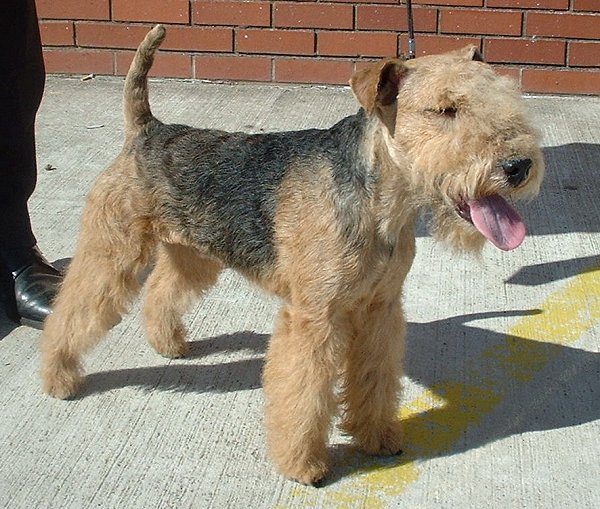
At 7–8 kg (15–17 lb), the Lakeland is the smallest of the long-legged black and tan terriers. It looks like the slightly bigger Welsh Terrier but is finer in bone. Most stand 34–38 cm (13.5–15 in) at the withers. It is sturdy and compact, and moves freely and fast.
The chest is fairly narrow and the muzzle broad. The ears are small and V-shaped, and the eyes small, dark and oval. The tail is carried upright; it used to be docked in the United Kingdom and still customarily is in the United States.
The outer coat is thick, bushy and wiry over a soft undercoat. The Kennel Club accepts black and tan, blue and tan, red, wheaten, red grizzle, liver, blue and black. The nose and pads are black, except in liver dogs, where they are liver.
Temperament
Lakelands are friendly, bold and confident, rarely shy and not usually aggressive. They are independent but get along well with the whole family. They are intelligent and quick to learn, though like other terriers they can stop listening when something catches their interest. They take well to crate training.
Care and health
This is an energetic dog that needs exercise every day. The coat does not shed if it is properly groomed, and regular stripping and trimming improve its texture.
A 2024 study in the United Kingdom found a life expectancy of 14.2 years, above the average for purebred dogs.
Facts on this page were checked against Wikipedia and may have changed since.