Tamaskan Dog
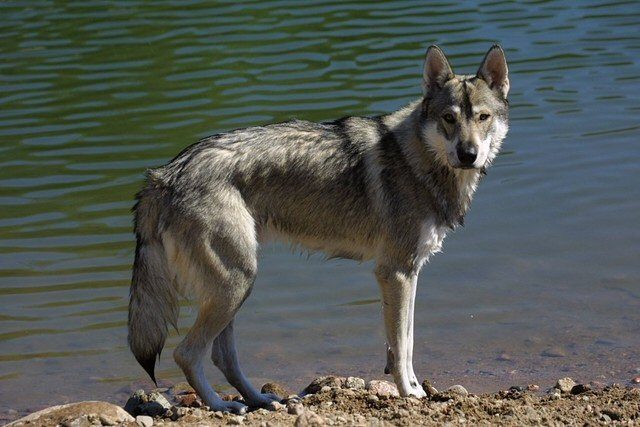

- Origin
- Finland
- Type
- Working
- Size
- Large
- Height
- 60–70 cm (24–28 in)
- Weight
- 25–40 kg (55–88 lb)
- Coat
- Thick double coat with a dense undercoat and coarse outer coat
- Colors
- Wolf gray, red gray or black gray
- Status
- Recognised by the American Rare Breed Association; not recognised by the FCI
The Tamaskan is a dog bred on purpose to look like a wolf or wolfdog. It is associated with Finland, though its exact origins are uncertain. It comes from mixed-breed stock, mainly crosses of arctic breeds: Alaskan husky, Alaskan Malamute, Canadian Eskimo dog, German Shepherd, Labrador husky and Siberian Husky.
History
The Tamaskan grew out of a British project. In the 1980s five dogs of Siberian Husky origin were imported from the United States to the United Kingdom and bred to Alaskan Malamutes, Siberian Huskies and German Shepherds. The aim was a dog with the look of a wolf and a good temperament. At the time such dogs were simply called wolf lookalikes, and records were poorly kept, so the ancestry of most of them is unknown. Over the years the project split into several related breeds, among them the Northern Inuit dog, the Utonagan and the British timber dog.
Lynn Hardey and Jennie Peacock, committee members of a Utonagan society, came to believe their dogs were growing too closely related and looked abroad for new blood. In Finland they found working husky crosses and bought several to add to their lines. Most Utonagan breeders were not interested in the additions, so the two left and founded the Tamaskan Dog Register in 2006. There are now breed clubs in the United States, Canada, France, Germany, the Netherlands, Croatia and the United Kingdom.
Tamaskans have played wolves on stage and screen. One named Luchta took the wolf’s part in a 2016 Broadway production of The Crucible, and another, known as Tuffy, has been the live mascot of the NC State Wolfpack since 2010.
Appearance
The Tamaskan is a large, athletic dog, a little taller than a German Shepherd, bigger than a typical sled dog but smaller than an Alaskan Malamute. Adults average 60 to 70 cm at the shoulder and usually weigh 25 to 40 kg; the heaviest males recorded are just under 50 kg. Males are heavier in bone with broader heads, and females are somewhat smaller and lighter.
The look is wolf-like, with a straight, bushy tail and a thick double coat in wolf gray, red gray or black gray. Each guard hair is banded along its length. The almond-shaped eyes run from yellow through amber to brown; blue or mismatched eyes are not accepted.
Care and health
The Tamaskan is healthy overall, with a few problems in a small share of bloodlines. About one male in ten has an undescended testicle. Epilepsy has been diagnosed in five dogs, roughly one in every hundred registered. Several dogs have been found to carry degenerative myelopathy, and hip dysplasia is a risk, as it is for large dogs generally.
Facts on this page were checked against Wikipedia and may have changed since.