Bernese Mountain Dog
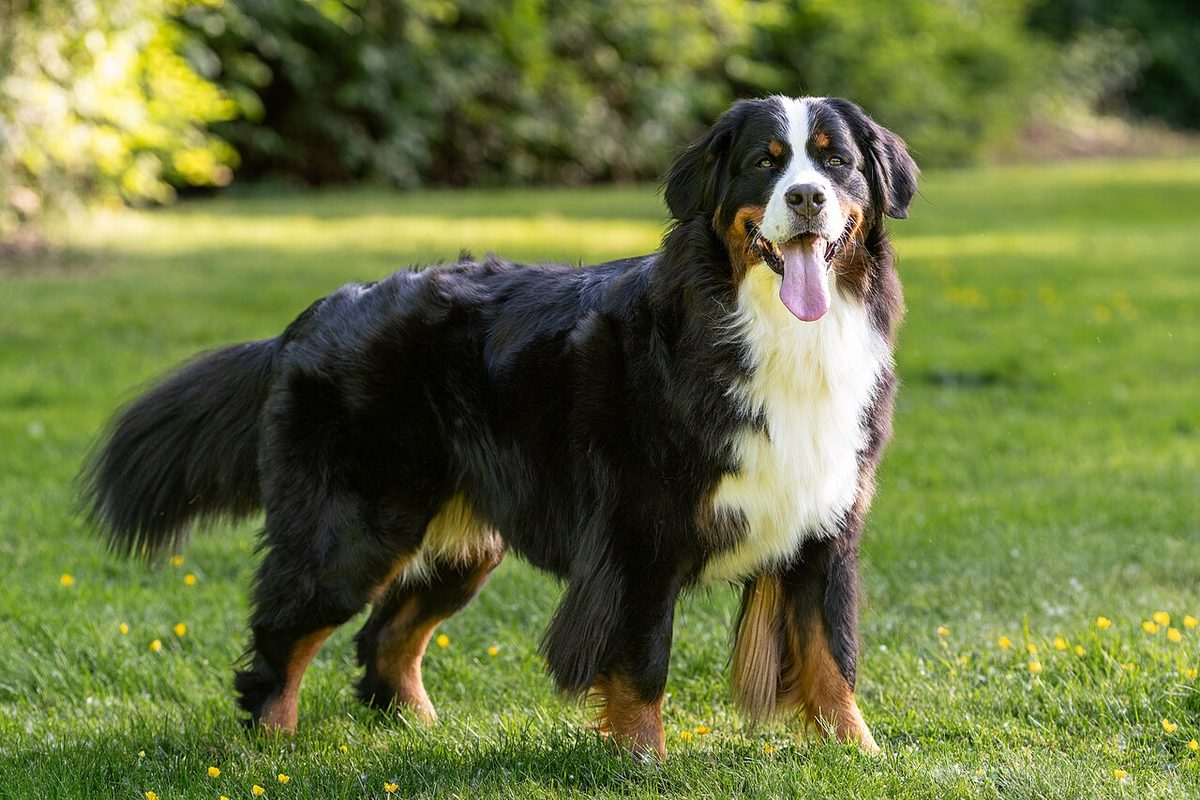

- Origin
- Switzerland
- Type
- Working
- Size
- Large
- Height
- 58–70 cm (23–28 in)
- Weight
- 35–55 kg (77–121 lb)
- Coat
- Long double coat
- Colors
- Tricolor: black with rust and white markings
- Life span
- About 8–10 years
- Status
- Recognised by the FCI and AKC
The Bernese Mountain Dog is a large farm dog from the canton of Bern and the Swiss Alps. It is one of the four Sennenhund breeds, named for the Senn, the alpine herders and dairymen the dogs accompanied, and the only one of the four with a long coat.
History
The breed traces its roots to Roman mastiffs. On Swiss farms it was an all-purpose dog: it guarded the property, drove dairy cattle the long distances between the farm and the alpine pastures, and pulled carts loaded with milk and cheese, which earned it the local nickname “Cheese Dog”. In some places it was called the Dürrbachhund or Dürrbächler, after the small town of Dürrbach where the big dogs were especially common.
In the early 1900s, fanciers showed the few remaining examples at dog shows in Bern. In 1907 breeders from the Burgdorf region founded the first breed club, the Schweizerischer Dürrbach-Klub, and wrote the first standard, which set the dogs apart as a breed of their own. By 1910 there were 107 registered dogs, and the breed was formally recognized in 1912.
The American Kennel Club recognized the Bernese in 1937 and places it in its Working Group. It is a very popular family dog in German-speaking countries.
Appearance
The Bernese is a large, heavy, strongly muscled dog, slightly longer than it is tall, with a broad, firm back. The head is flat on top with a moderate stop, and the ears are medium-sized, triangular, set high and rounded at the tip. The tail is bushy and carried low.
The long coat is always tricolored: a black ground with rust markings over the eyes, at the sides of the mouth, on the front of the legs and around the white chest. A well-marked dog has a white horseshoe shape around its black nose and a white “Swiss cross” on the chest. Males stand about 64–70 cm at the withers and females 58–66 cm. Males weigh roughly 35–55 kg and females 35–45 kg.
Temperament
The Bernese has a calm nature. It has been described as energetic, attentive and impetuous but not inclined to bite. It tends to attach itself to one person and is naturally wary of strangers. It tolerates hard winters well and is a keen defender of home and stable.
Care and health
The breed’s calm character suits it to pulling small carts or wagons, its old job in Switzerland, and carting workshops and competitions are held for it.
Life expectancy is short, even for a dog of this size. Studies in Switzerland, the Netherlands and France found figures of 8 to 8.4 years, and a 2024 UK study found 10.1 years. Cancer is common; one study attributed 55% of deaths to it. Malignant histiocytosis, a fast-moving inherited cancer, accounts for about a quarter of all tumors in the breed, and the risk of high-grade mast cell tumors is also raised. Other conditions seen more often in the Bernese include elbow dysplasia, degenerative myelopathy, immune-mediated glomerulonephritis and other kidney disease, and type I von Willebrand’s disease.
Facts on this page were checked against Wikipedia and may have changed since.