Irish Wolfhound

- Origin
- Ireland
- Type
- Sighthound
- Size
- Giant
- Height
- 71–86 cm (28–34 in)
- Weight
- From 40.5 kg (89 lb)
- Coat
- Rough and hard, wiry over the eyes and under the jaw
- Colors
- Black, brindle, fawn, gray, red or pure white
- Life span
- Under 10 years
- Status
- Recognised by the FCI
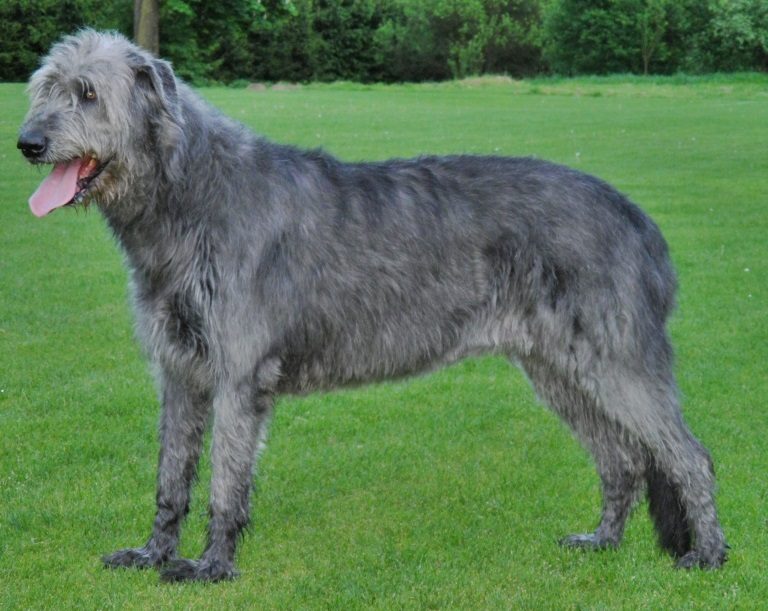
The Irish Wolfhound is a very large, rough-coated sighthound and one of the biggest of all dog breeds. Its Irish name, Cú Faoil, joins the words for hound and wolf. Coursing hunters have valued it for its power to finish off game caught by faster sighthounds. Since 1902 it has been the regimental mascot of the Irish Guards.
History
The Gaels hunted with wolfhounds, and hounds appear in Irish laws and literature from the sixth century on. Dog bones from Irish sites, however, show no animals of today’s wolfhound size before about 1200, so the great height seems to be a fairly modern development.
So many wolfhounds were sent abroad to royal houses that in 1652 a declaration by Oliver Cromwell sought to keep enough in Ireland to control the wolves. The last known wolf in Ireland was killed in County Carlow in 1786. After that the few remaining wolfhounds were status symbols in the hands of a few families, and the dog became very scarce.
The modern breed is the work of Captain George Augustus Graham of Gloucestershire, England. He admitted that the original breed could no longer be found intact. He started with two Irish dogs said to descend from the old strains, Faust of Kilfane and Old Donagh of Ballytobin, and relied heavily on the Scottish Deerhound and the Great Dane. Graham founded the Irish Wolfhound Club in 1885 and set out the standard. Genomic analysis shows a good deal of DNA shared with the Great Dane, so Graham recreated the look of the old hound more than its ancestry.
Appearance
Under the FCI standard, height at the withers is expected to be 81 to 86 cm (32 to 34 in). Males must be at least 79 cm (31 in) and 54.5 kg (120 lb), females at least 71 cm (28 in) and 40.5 kg (89 lb). The build is heavier than a Deerhound’s and lighter than a Great Dane’s.
The coat is hard and rough on the head, body and legs, and especially wiry in the beard and over the eyes. It may be black, brindle, fawn, gray, red, pure white or any color seen in the Deerhound.
Temperament
Wolfhounds vary a good deal and are known for their individual quirks. In general they are intelligent, reserved and rather introverted. They bond closely with their family and with dogs they grow up with, and can become destructive or morose if left alone for long. They are often friendly to strangers, which makes them unreliable watchdogs, though their size is a deterrent in itself. The breed’s old motto is “gentle when stroked, fierce when provoked”.
Care and health
Like many very large dogs, the Irish Wolfhound is short-lived. Published estimates range from 4.95 to 8.75 years, and a 2024 UK study found 9.9 years. The diseases most often reported are dilated cardiomyopathy, which is probably hereditary in the breed, bone cancer, gastric dilatation volvulus and osteochondrosis.
Facts on this page were checked against Wikipedia and may have changed since.