Greenland Dog

- Origin
- Greenland
- Type
- Sled dog
- Size
- Large
- Height
- From 55 cm (22 in) for females and 60 cm (24 in) for males
- Coat
- Thick double coat of medium length
- Colors
- Any color from fawn to black, except albino and merle
- Status
- Recognised by the FCI and The Kennel Club
The Greenland Dog is a large husky-type dog kept as a sled dog. It descends from dogs that the Thule people brought from Siberia to North America about 1,000 years ago. The Canadian Eskimo Dog shares that descent, and the two are sometimes considered the same breed.
History
Dogs first appeared in Greenland around 4,000 years ago. A 2020 genetic study found that Greenland sled dogs have been kept apart from other breeds since they arrived with the Inuit some 850 years ago, and that their lineage reaches back further than that of other Arctic breeds, to dogs that lived in northeastern Siberia 9,500 years ago. On that basis Guinness World Records counts the Greenland Dog among the oldest dog breeds. A 2015 study concluded that the Greenland Dog and the Canadian Inuit dog are the same dog, distinct from Siberian Huskies, Alaskan Huskies and Malamutes.
Centuries of hauling loads in the Arctic gave the breed its strength, heavy coat and endurance. An Esquimaux bitch was shown in Darlington, England, in 1875, and The Kennel Club recognized the breed at its foundation in 1880. Roald Amundsen used Greenland Dogs on the expedition that first reached the South Pole.
The dog is treated as nationally and culturally important in Greenland. North of the Arctic Circle in the west, and throughout the east, it is illegal to bring in dogs from outside, and since 2017 every dog must be microchipped and registered. The population has been falling, from about 15,000 in 2016 to 12,000 in 2021, and several projects aim to keep the breed and the sledding culture alive.
Appearance
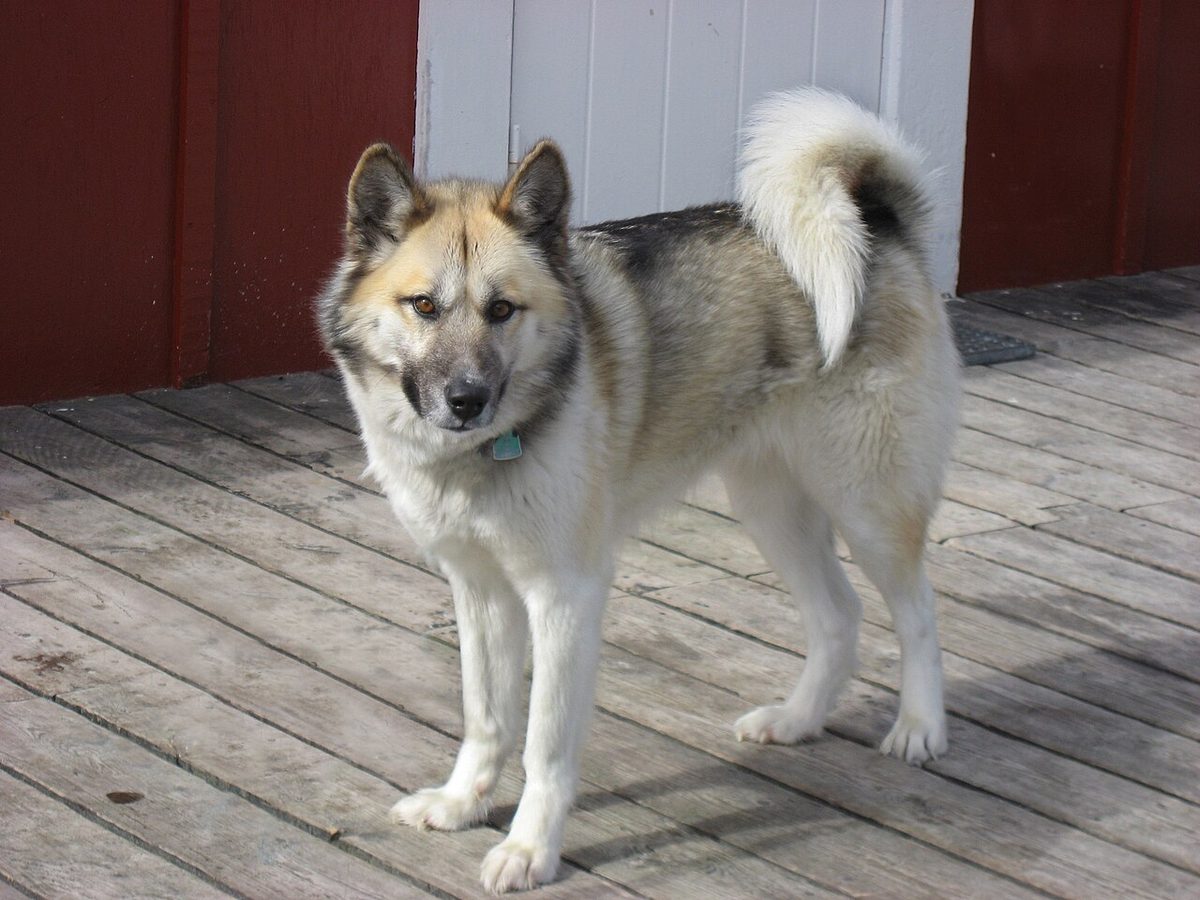
The Greenland Dog is powerful and heavily built, with a broad, wedge-shaped head, slightly tilted eyes and small triangular ears thickly furred against frostbite. The legs are strong and muscular. The tail is usually rolled over the back, and a resting dog often curls up with its tail over its nose. The coat has two layers: short, woolly fur beneath and longer, coarser, water-repellent hair on top. Any color from black to fawn is accepted, apart from albino and merle, and blue eyes or odd-colored eyes are disqualified by the standard. Most dogs have a triangular patch on the shoulders called the úlo, named after a Greenlandic woman’s knife of the same shape.
Males stand 60 cm or more at the withers and females 55 cm or more. The breed has the strength and stamina a sled dog needs and moves fast and easily over difficult ground.
Facts on this page were checked against Wikipedia and may have changed since.