Alaskan Malamute

- Origin
- Alaska
- Type
- Sled dog
- Size
- Large
- Height
- 58–64 cm (23–25 in)
- Weight
- 34–39 kg (75–85 lb)
- Coat
- Thick double coat with a woolly undercoat
- Colors
- Gray, sable, black, seal or red, always with white; or solid white
- Life span
- About 11 years
- Status
- Recognised by the FCI and AKC
The Alaskan Malamute is a large spitz-type dog bred to pull heavy loads over long distances as a sled dog. It is thought to have been developed by the Malimiut Inupiaq people of the Norton Sound region of Alaska, and it resembles other arctic breeds such as the Siberian Husky, the Greenland Dog, the Canadian Eskimo Dog and the Samoyed.
History
Malamutes lived and worked beside their people as all-purpose dogs. They hauled supplies, helped hunt large animals such as bears, and found seal blowholes in the ice. They were freight dogs, not racers: teams of four or more pulled heavy loads to villages and camps.
Genetic studies describe the Malamute as a basal breed, older than the modern breeds that appeared in the 19th century. A 2015 study found it closely related to the Siberian Husky and the Alaskan husky, with links to the sled dogs of Chukotka in Siberia, and separate from the Greenland Dog and the Canadian Eskimo Dog.
During the Klondike Gold Rush of 1896, sled dogs became very valuable to prospectors and settlers, and many were crossed with imported breeds. Malamutes later went with Rear Admiral Richard Byrd’s expedition to the South Pole and served in World War II, mainly as search and rescue dogs in Greenland and as freight and pack dogs in Europe. In 2010 the Alaskan Malamute was named the official state dog of Alaska.
Appearance
The AKC standard gives a desired size of 58 cm (23 in) and 34 kg (75 lb) for females and 64 cm (25 in) and 39 kg (85 lb) for males, though heavier and lighter dogs are common and some weigh more than 45 kg (100 lb). Males are often clearly larger than females.
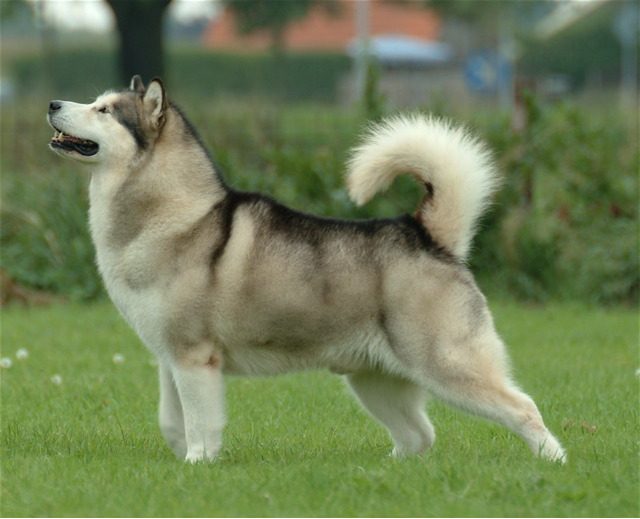
This is a heavy, compact, strongly boned dog with large snowshoe feet. The double coat has an oily, woolly undercoat that can be up to two inches thick under a coarse outer coat. The usual colors are shades of gray, sable, black, seal or red combined with white, or solid white, with white on the underside, legs, feet and face.
The ears are small, wedge-shaped and upright. The eyes are almond-shaped and brown, with darker shades preferred; blue eyes are not found in purebred Malamutes. The muzzle is deep and broad. The well-furred tail is carried over the back like a waving plume, and a Malamute curled up in the snow will often wrap it over its nose and face.
Care and health
A 2024 UK study found an average life expectancy of 11.3 years. In a 2004 Kennel Club survey, the problems most often reported were hip dysplasia and hereditary cataracts. Other conditions seen in the breed include elbow dysplasia, inherited polyneuropathy, osteochondrodysplasia, cerebellar hypoplasia, heart defects, progressive retinal atrophy, epilepsy, kidney problems and skin disorders.
Malamutes do not absorb zinc easily, and a deficiency can lead to infections or skin and coat problems. Hypothyroidism is common.
Facts on this page were checked against Wikipedia and may have changed since.