American Water Spaniel

- Origin
- United States
- Type
- Gundog
- Size
- Medium
- Height
- 38–46 cm (15–18 in)
- Weight
- 11–20 kg (25–45 lb)
- Coat
- Double coat with a curly or wavy outer layer
- Colors
- Liver, brown or chocolate
- Life span
- 10–13 years
- Status
- Recognised by the FCI, AKC and UKC
The American Water Spaniel is a medium-sized, curly-coated brown spaniel developed in Wisconsin in the 19th century. Hunters there wanted one dog that could work on both land and water, cope with cold water and still fit in a small skiff. It is the state dog of Wisconsin and remains a rare breed.
History
The breed took shape in the early 19th century along the Fox River and its tributary, the Wolf River. The breeds thought to have gone into it include the English Water Spaniel, the Irish Water Spaniel, the Curly Coated Retriever, native Indian dogs, the Poodle and either the Sussex Spaniel or another field spaniel. The result, then called the American Brown Spaniel, was used on waterfowl, ruffed grouse, prairie chicken and fur-bearing animals.
Numbers fell as duck populations dropped and hunting changed from a way of getting food to a pastime. After World War II, setters, pointers and other spaniels also became available in Wisconsin. Dr. Fred J. Pfeifer of New London, Wisconsin, set up Wolf River Kennels to save the breed, at times keeping as many as 132 dogs and advertising them across the country. Through his work the United Kennel Club recognized the breed as the American Water Spaniel in 1920, and his own dog, Curly Pfeifer, was the first registered. The Field Dog Stud Book followed in 1938 and the American Kennel Club in 1940.
The breed is thought to have been the main one used to develop the Boykin Spaniel, though the Boykin clubs dispute one version of that story. It became Wisconsin’s state dog in 1985. In 1998 only 233 puppies were registered with the AKC, and about 3,000 dogs were thought to exist, mostly in Wisconsin, Minnesota and Michigan. The breed is classified as neither a spaniel nor a retriever, so it cannot run in AKC field trials, though it can enter hunt tests.
Appearance
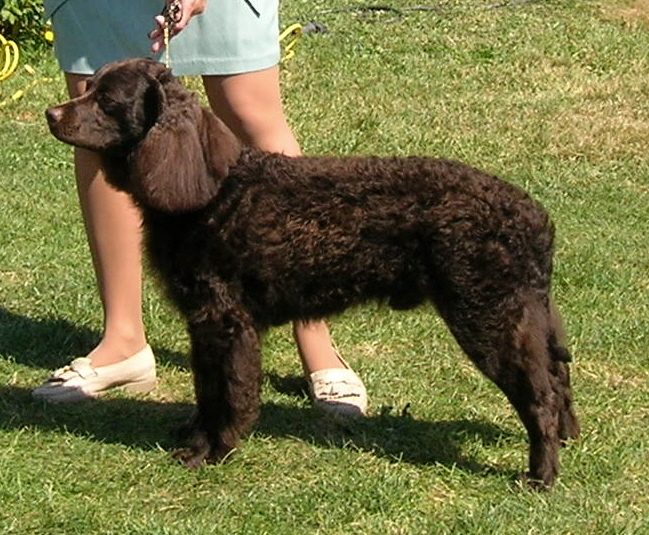
The breed has changed little since its beginnings. It stands 38 to 46 cm at the withers and weighs about 11 to 20 kg, smaller than the Irish Water Spaniel it resembles. The coat is liver, brown or chocolate, and either tightly curled or falling in waves known as the marcel pattern. A coarse outer layer sheds water and protects against briers, and the inner layer keeps the dog warm. The coat feels oily. The skull is broad, the ears long and wide, and the tail is not usually docked. Eye color should match the coat and never be yellow. Working and show dogs look the same.
Temperament
In the field the American Water Spaniel is calmer than an English Springer Spaniel and a capable retriever. It is not a fast swimmer but has plenty of stamina, and it does well at agility and flyball. It likes attention, can be vocal, and tends to bond with one family and often one person in it. It learns well, especially when training is varied, but can be stubborn, slow to mature and possessive over food. Some lines are still dominant or aggressive. Otherwise the breed gets on well with children, and with enough exercise it can live in an apartment.
Care and health
Early pack breeding left the breed with good genetic variety, so many inherited conditions of more popular breeds are uncommon. Eye problems do occur, including cataracts, often before one year of age, and progressive retinal atrophy. Other concerns are hypothyroidism, allergies, epilepsy, diabetes and glandular disorders that can cause hair loss on the neck, thighs and tail from about six months old. Surveys between 1974 and 1999 found hip dysplasia in about 8.3 percent of dogs and no elbow dysplasia.
Facts on this page were checked against Wikipedia and may have changed since.