Mexican Hairless Dog
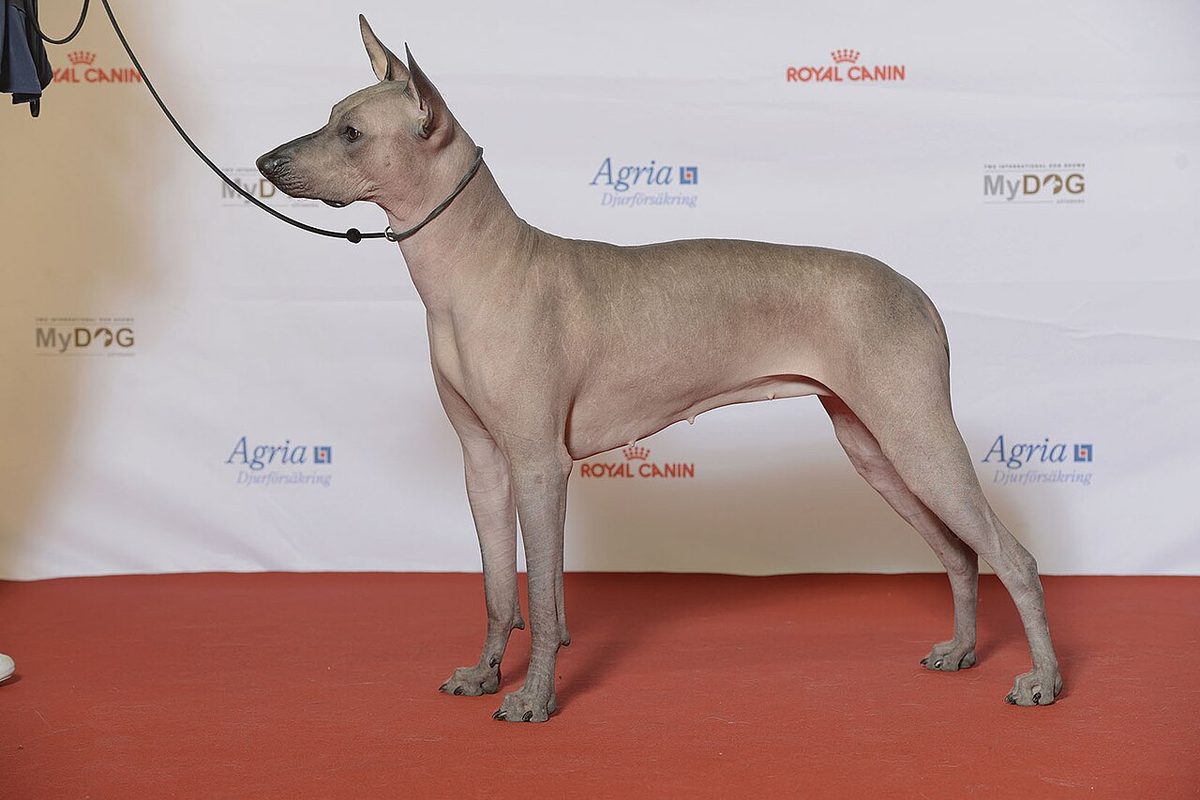

- Origin
- Mexico
- Type
- Primitive
- Height
- 23–67 cm (9–26 in)
- Weight
- 4.5–25 kg (10–55 lb)
- Coat
- Hairless, or a short, flat, dense coat
- Colors
- Any color; most often black, gray, bronze, yellowish blonde, blue or red
- Status
- Recognised by the FCI and AKC
The Mexican Hairless Dog is the hairless form of the Xoloitzcuintle, or Xolo, the national dog of Mexico. The breed comes in three sizes and two varieties, hairless and coated, and both kinds can be born in the same litter. Its name comes from Nahuatl: Xolotl, the Aztec god of fire and lightning said to have created the dog, and itzcuintli, meaning dog.
History
Ceramic figures of hairless dogs have been found in ancient burial sites in western Mexico. Dogs that looked like today’s Xolos were often sacrificed and buried with their owners, to guide the soul on its way to the underworld. Their remains have been found in Maya and Toltec burials. Spanish accounts from the sixteenth century also describe dogs being served as food at Aztec feasts.
Genetic work indicates that the dogs of pre-Columbian America descended from domestic dogs that came from Siberia with people more than 9,000 years ago. A 2020 study found that the modern Xolo owes only about 3 percent of its ancestry to those early dogs.
The Xolo was one of the first breeds recorded by the American Kennel Club, which registered a Mexican dog called Mee Too in 1887. In 1959 the club dropped the breed because it had become so scarce.
In Mexico, Xolos started to appear at dog shows in the late 1940s, but there was little interest and no standard. Fearing the breed would die out, the FCI backed the Xolo Expedition of 1954, in which Norman Pelham Wright and a team of Mexican and British dog experts searched remote parts of Mexico. They found ten sound dogs, which became the foundation of the revival. The breed was officially recognized in Mexico on May 1, 1956.
The Xoloitzcuintli Club of America was founded in 1986 to win back American recognition. The breed returned to the American Kennel Club’s stud book in December 2010 and has been shown in the Non-Sporting group since 2011.
Appearance
The Xolo is a sleek dog with almond-shaped eyes, large bat-like ears and a long neck, a little like a Pharaoh Hound. It is moderate in build and slightly longer than tall. Breeders divide it into three sizes. Across them, height runs from 23 to 67 cm (9 to 26 in) and weight from about 10 to 55 lb.
The hairless variety has no hair on the body, though many dogs have a few short hairs on the top of the head, the toes and the tip of the tail. Most are black or bluish gray. The skin is often marked, splashed or spotted.
Hairlessness is a dominant trait that arose as a mutation thousands of years ago. Puppies that inherit the gene from both parents do not survive to birth, so hairless dogs always carry the coated gene too and most litters include both kinds. The coated variety, with its short, flat, dense coat, is the original form of the dog. The same gene affects the teeth: hairless Xolos usually have some missing, while coated dogs have a full set.
Temperament
The Xolo is calm and attentive.
Care and health
Coming from the tropics, the breed is not suited to living outdoors in colder climates and is best kept as an indoor dog. The skin needs regular bathing, light grooming and basic care; neglect can lead to acne and other skin trouble. Too much bathing and moisturizing cause problems as well, by stripping the skin’s natural oils and clogging the pores.
Facts on this page were checked against Wikipedia and may have changed since.