Otterhound

- Origin
- England
- Type
- Scenthound
- Size
- Large
- Height
- 61–69 cm (24–27 in)
- Weight
- 36–52 kg (80–115 lb)
- Coat
- Rough, dense, waterproof double coat
- Colors
- Whole colored, grizzle, sandy, red, wheaten or blue, with white or pied markings allowed
- Life span
- About 10 years
- Status
- Recognised by the FCI and The Kennel Club, which lists it as a Vulnerable Native Breed
The Otterhound is a large English scenthound that was bred to hunt otters. It is now very rare: The Kennel Club lists it as a Vulnerable Native Breed, and around 600 are thought to exist worldwide.
History
Otter hunting goes back to the early medieval period, with references as early as 1360. The Otterhound itself can be traced as a distinct breed only to the 18th century. The first hounds known to resemble today’s breed were in the northwest of England in the first half of the 19th century, in packs such as the Hawkstone Otter Hunt and Squire Lomax’s. Otterhounds first appeared at a dog show in Leeds in 1861.
In the second half of the 19th century French griffons were crossed in, among them hounds from the Comte de Canteleu in Normandy. The Griffon Nivernais was added in the early 20th century. One dog named Boatman, a cross of Grand Griffon Vendéen and Bloodhound, became an ancestor of several kennels.
An old saying held that to match the otter, the hound needed a Bulldog’s courage, a Newfoundland’s strength in water, a Pointer’s nose, a Retriever’s sagacity, a Foxhound’s stamina, a Beagle’s patience and a Collie’s intelligence.
Otter numbers fell sharply, and in 1978 the otter became a protected species in Britain, which ended otter hunting. Nine registered packs still existed in 1977. A few turned to hunting mink or coypu, but many disbanded, and hounds were often passed to new minkhound packs. Only one pack today is made up of pure Otterhounds. Because the hounds had been bred for hunting ability, only a few bloodlines were suitable for breeding companion dogs.
The breed has never been numerous, even when otter hunting was at its height in the early 20th century. In 2012 the world population was put at about 600, and only 41 were newly registered in 2016. It is considered Britain’s most endangered native breed.
Appearance
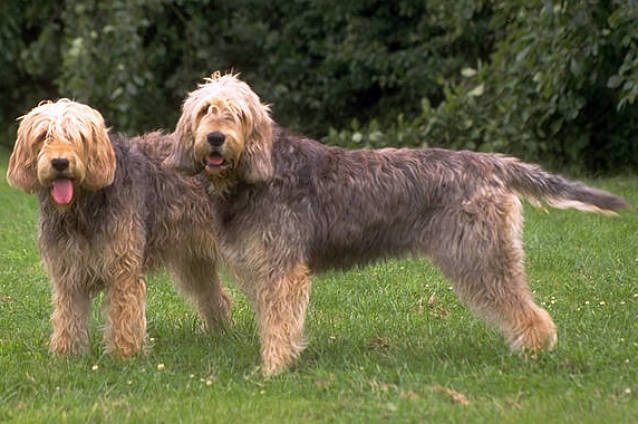
The Otterhound is a large, rough-coated, straight-limbed dog. Males stand 69 cm at the shoulder and females 61 cm, and the dogs generally weigh between 36 and 52 kg.
The head is deep but not wide, and the rough coat gives it a beard and moustache. The nose is wide and the eyes deep-set. The long, hanging ears roll inward so that they seem to drape. The neck is long, the hind legs heavily muscled, and the feet large, round and thickly padded. The tail is thick at the base and never curls over the back.
The coat is 4–8 cm long, dense, rough and waterproof, with a broken look. It is a double coat, with a soft undercoat beneath the harsher outer hair, and both layers are slightly oily. Accepted colors are whole colored, grizzle, sandy, red, wheaten and blue, any of them with white markings, as well as white with lemon, blue or badger pied markings.
Care and health
A survey of UK breed club members found a life expectancy of 10.21 years. It also found a predisposition to gastric dilatation volvulus: 9 percent of Otterhounds had suffered it, and it accounted for 7.4 percent of deaths.
Facts on this page were checked against Wikipedia and may have changed since.