Cesky Terrier

- Origin
- Czech Republic
- Type
- Terrier
- Size
- Small
- Height
- 24–32 cm (9.5–12.5 in)
- Weight
- 5.9–10 kg (13–22 lb)
- Coat
- Long, fine and silky, slightly wavy
- Colors
- Gray from charcoal to platinum, or rarely coffee brown
- Status
- Recognised by the FCI, AKC and The Kennel Club
The Cesky Terrier is a small, short-legged terrier from what was then Czechoslovakia. Its Czech name, Český teriér, means Bohemian or Czech Terrier, and it was created for hunting in the forests of Bohemia.
History
The breed was the work of one man, the Czech breeder František Horák, who crossed a Sealyham Terrier with a Scottish Terrier in 1948. Horák was not a trained scientist, but he spent years as a research assistant at the Czechoslovak Academy of Sciences and applied what he learned there to his breeding. As his dogs became known abroad, the amount of foreign mail he received drew the attention of the communist state’s secret police. He died in 1997.
The Fédération Cynologique Internationale recognized the Cesky in 1963, as breed 246 in its terrier group. It reached Britain in 1989 and was recognized by The Kennel Club in 1990. Enthusiasts brought the first dogs to the United States in the 1980s and founded the Cesky Terrier Club of America in 1988. The breed entered the American Kennel Club’s Foundation Stock Service in 2004 and joined the AKC stud book and terrier group in mid-2011. It is counted among the six rarest dog breeds in the world.
Appearance
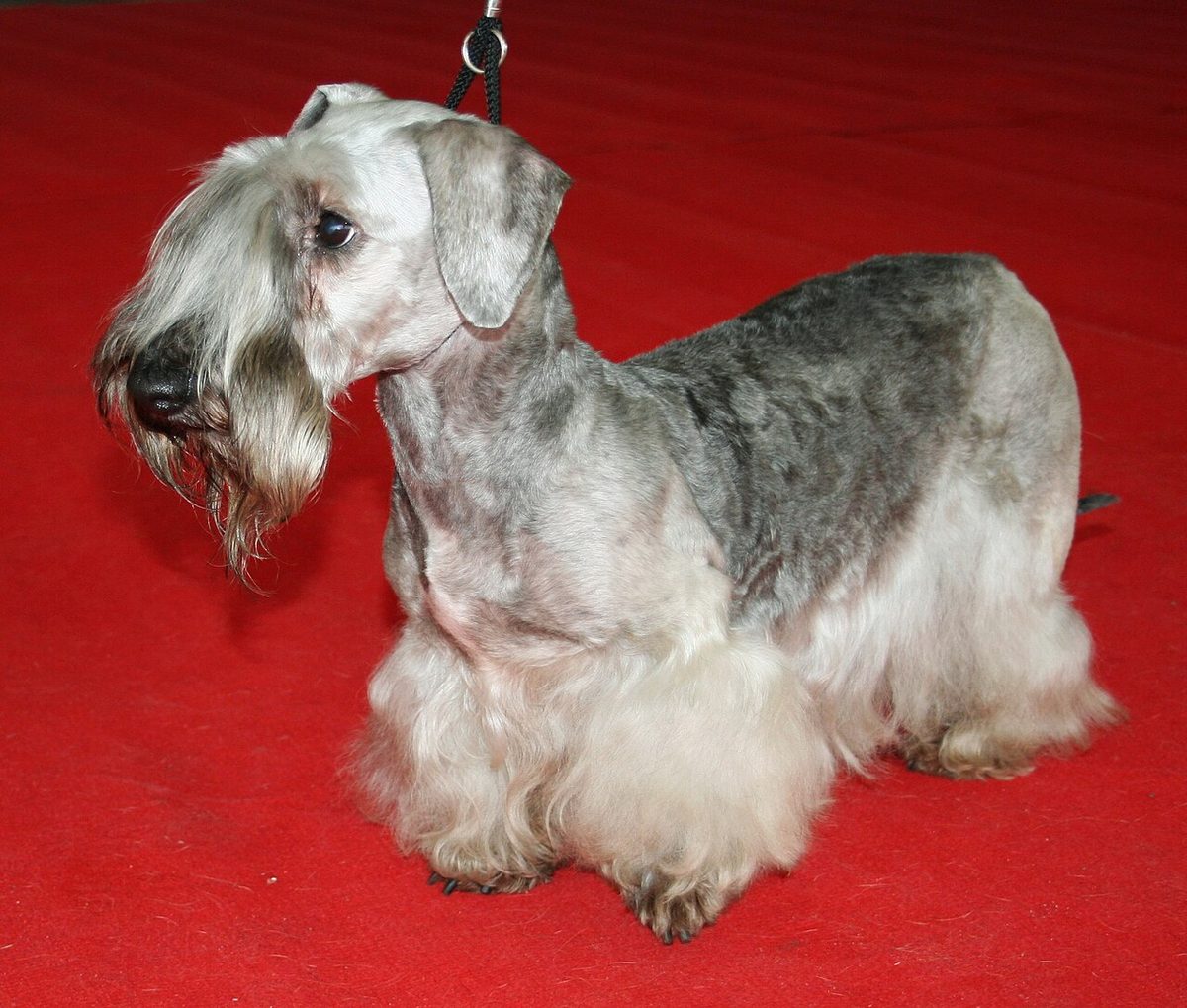
The Cesky is a muscular hunting terrier, longer than tall, with a topline that rises a little toward the rear. The FCI standard gives an ideal height of about 29 cm for males and 27 cm for females, within limits of 24 and 32 cm, and an ideal weight of 5.9 to 10 kg. It has drop ears shaped like triangles, a natural tail, and a head like a long, blunt wedge. The expression should be calm and kind.
The coat is long, fine and slightly wavy with a silky gloss. Mature dogs are any shade of gray from charcoal to platinum, with black pigment, or more rarely coffee brown with liver pigment. Some white, gray, brown or yellow markings are allowed on the head, neck, chest and legs, as long as the base color dominates.
Temperament
The standard asks for a calm dog and treats aggression as a disqualifying fault. Ceskys have a reputation for being quieter and less active than other terriers.
Care and health
Unlike most terriers, the Cesky is clipped and not hand-stripped. The body is clipped short in a saddle pattern, leaving longer hair on the legs and underside, and the hair on the foreface is left to form eyebrows and a beard. The longer hair should be brushed every day.
The breed sometimes has Scotty cramp, a minor condition that causes awkward movement and is not life-threatening. Hip dysplasia, patella luxation, heart abnormalities, primary lens luxation, cataracts, thyroid problems, degenerative myelopathy and Type 3 von Willebrand disease have all been documented, and breeding stock should be checked for them.
Facts on this page were checked against Wikipedia and may have changed since.