Australian Kelpie
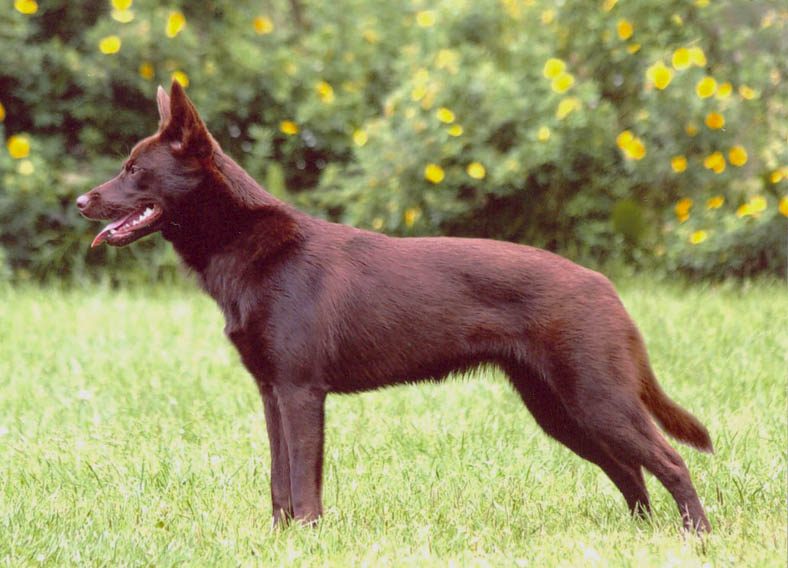

- Origin
- Australia
- Type
- Herding
- Size
- Medium
- Height
- 41–51 cm (16–20 in)
- Weight
- 14–20 kg (31–44 lb)
- Coat
- Short double coat; working dogs may be smooth or rough
- Colors
- Black, red, chocolate, blue, fawn or cream, with or without tan
- Life span
- About 12 years
- Status
- Recognised by the FCI, ANKC, UKC and Canadian Kennel Club; not by the AKC
The Australian Kelpie is a medium-sized sheepdog from Australia that can muster and drive livestock with little or no guidance. It works mainly sheep, cattle and goats and has been exported around the world. There are two varieties: the Working Kelpie, bred for ability, and the Show or Bench Kelpie, bred for appearance.
History
Most Kelpies descend from black or dark brown British working dogs loosely called collies, brought to Australia in the early 19th century and bred with other dogs to work sheep without close supervision. A long-told story says the first Kelpies came from a cross between a collie and a dingo around 1870. A 2019 genetic study was reported as finding no dingo ancestry, but its lead author later said it had only looked at genes for ear shape and coat color, not the whole genome.
The first dog called Kelpie was a black and tan female bought by Jack Gleeson about 1872 from a litter born on Warrock Station near Casterton, and named after the water spirit of Celtic folklore. Her daughter, known as King’s Kelpie, tied for the Forbes Trial in 1879, and the strain became known as Kelpie’s pups, then simply Kelpies. A black pup named Barb gave black Kelpies the name Barbs. Robert Kaleski published the first standard in 1904.
Kelpies have also been trained as scent dogs, and in Sweden they are widely used for tracking and rescue.
Appearance
The Kelpie is an athletic dog, usually with prick ears. It generally stands 41–51 cm (16–20 in) at the withers and weighs 14–20 kg (31–44 lb). Colors include black, red, blue, fawn and cream, with or without tan.
Working Kelpies are registered with the Working Kelpie Council, which allows a wide range of colors and three coat types: short, smooth and rough. They vary more in size, up to about 64 cm (25 in) and 27 kg (60 lb). Show Kelpies are registered with the Australian National Kennel Council, which limits the colors accepted for showing; they have a double coat and pricked ears.
Temperament
Kelpies are intelligent, easy to train and good-tempered, and can be good pets, including with children. They need a great deal of exercise and mental work; a bored Kelpie may bark, dig or chew. Working Kelpies have a strong drive to herd and are often called workaholics. A well-known habit is running across the backs of tightly packed sheep to reach the other side and break up a jam.
Care and health
The Kelpie is a hardy breed with few health problems. Conditions that occur include cryptorchidism, hip dysplasia, cerebellar abiotrophy and luxating patella. A 2024 UK study found a life expectancy of 12 years.
Facts on this page were checked against Wikipedia and may have changed since.