American Foxhound
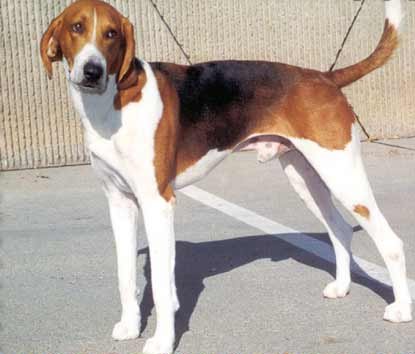

- Origin
- United States
- Type
- Scenthound
- Size
- Large
- Height
- 53–64 cm (21–25 in)
- Weight
- 25–32 kg (55–71 lb)
- Coat
- Short, close and hard
- Colors
- Any color; black, white and tan is most common
- Life span
- 10–12 years
- Status
- Recognised by the AKC and FCI
The American Foxhound is a scenthound from the United States, a close relative of the English Foxhound. It was bred for one job, following foxes by scent, and it is still worked in packs today. It is the state dog of Virginia.
History
The story starts in 1650, when Robert Brooke sailed from England to Maryland with his pack of hunting dogs. His hounds became the root of several American strains, and the Brooke family kept the bloodline going for nearly 300 years.
The American Kennel Club credits George Washington as the father of the breed. Washington wanted faster hounds with better tracking ability. He was given French hounds, Grand Bleu de Gascogne, by the Marquis de Lafayette, and about two years later added eight hounds from Philadelphia and two from England. These were combined with his own dogs, which descended from Brooke’s pack. Later, when the red fox became the quarry, Irish Foxhounds were added for speed and stamina.
The American Kennel Club recognised the breed in 1886. Several strains exist, including Walker, Calhoun, Goodman, Trigg, July and Penn-Marydel. They look different from one another but are all counted as one breed. Most show hounds are Walkers, while many mounted packs use Penn-Marydel hounds. The Trigg strain was developed in Barren County, Kentucky, in the 1860s by Colonel Haiden Trigg, who wanted a faster hound than those around him.
Appearance
The American Foxhound is taller and rangier than the English Foxhound. Standards ask for a height of about 53–64 cm (21–25 in) and a weight of 25–32 kg (55–71 lb), though many hounds, especially from show strains, stand taller. The legs are long and straight, the chest fairly narrow, the muzzle long and the skull large and slightly domed. The ears are wide and set low, and the large eyes are hazel or brown. The tail has a slight curve.
The coat is close, hard and of medium length. Any color is allowed, but black, white and tan together is the pattern seen most often.
Temperament
This is usually a calm hound that gets along with children and other animals. It is also very energetic and fast, and needs a lot of exercise and room to run. When hunting it gives a musical bay that carries for miles, which is one reason it does not suit city life.
Foxhounds are independent and can be stubborn. A hound that picks up a scent will follow it and ignore commands, so training takes patience and the breed should not be trusted off the leash. Despite its voice, it is not a good watchdog.
Care and health
The coat sheds a fair amount, and a weekly brushing helps. The breed does not generally carry genetic disorders, but it gains weight easily if overfed. A minor risk is thrombocytopathy, a platelet disorder that can cause excessive bleeding from small bumps or cuts. Hip dysplasia and some eye problems, once largely unknown in Foxhounds, now turn up occasionally. Most live 10 to 12 years.
Facts on this page were checked against Wikipedia and may have changed since.