Indian Pariah Dog

- Origin
- India
- Type
- Primitive
- Size
- Medium
- Height
- 46–64 cm (18–25 in)
- Coat
- Short double coat, coarse on top with a soft undercoat
- Colors
- Brown to reddish-brown or fawn, with or without white; sometimes pied, rarely black
- Status
- Not recognised by the major kennel clubs
The Indian pariah dog is a landrace native to the Indian subcontinent, a naturally evolved type rather than a breed shaped by breeders. It is one of the ancient pye-dogs, with upright ears, a wedge-shaped head and a curved tail, and it is widely used as a guard dog and police dog.
History
Dogs of this type have lived alongside people in the region for a very long time. There is archaeological evidence of them in Indian villages 4,500 years ago, a pariah-like skull was found at the Harappan site of Mohenjo-daro, and prehistoric rock art at Bhimbetka shows a similar dog. Today the landrace is found across India, Pakistan, Bangladesh, Afghanistan, Nepal and Sri Lanka, and beyond.
The name dates from the British Raj and comes from the Pariah tribe of the Madras Presidency. “Pye-dog” comes from a Hindi word meaning outsider. In India and Pakistan the dog is commonly called desi kutta, meaning native dog, and it is also known as the INDog or Indie dog. Under the Raj its qualities were played down by merchants who wanted to sell imported breeds.
Most street dogs in the subcontinent are pariah dogs, but not all. Some free-ranging dogs, especially near places where Europeans once settled, are mixes with European breeds.
In 2015 a breed standard was published in the Indian Kennel Gazette, the journal of the Kennel Club of India, and the dog is recognized by the Primitive and Aboriginal Dogs Society. At home, growing numbers of free-ranging dogs are seen by some as a nuisance and a danger, since unvaccinated dogs often carry rabies.
Appearance
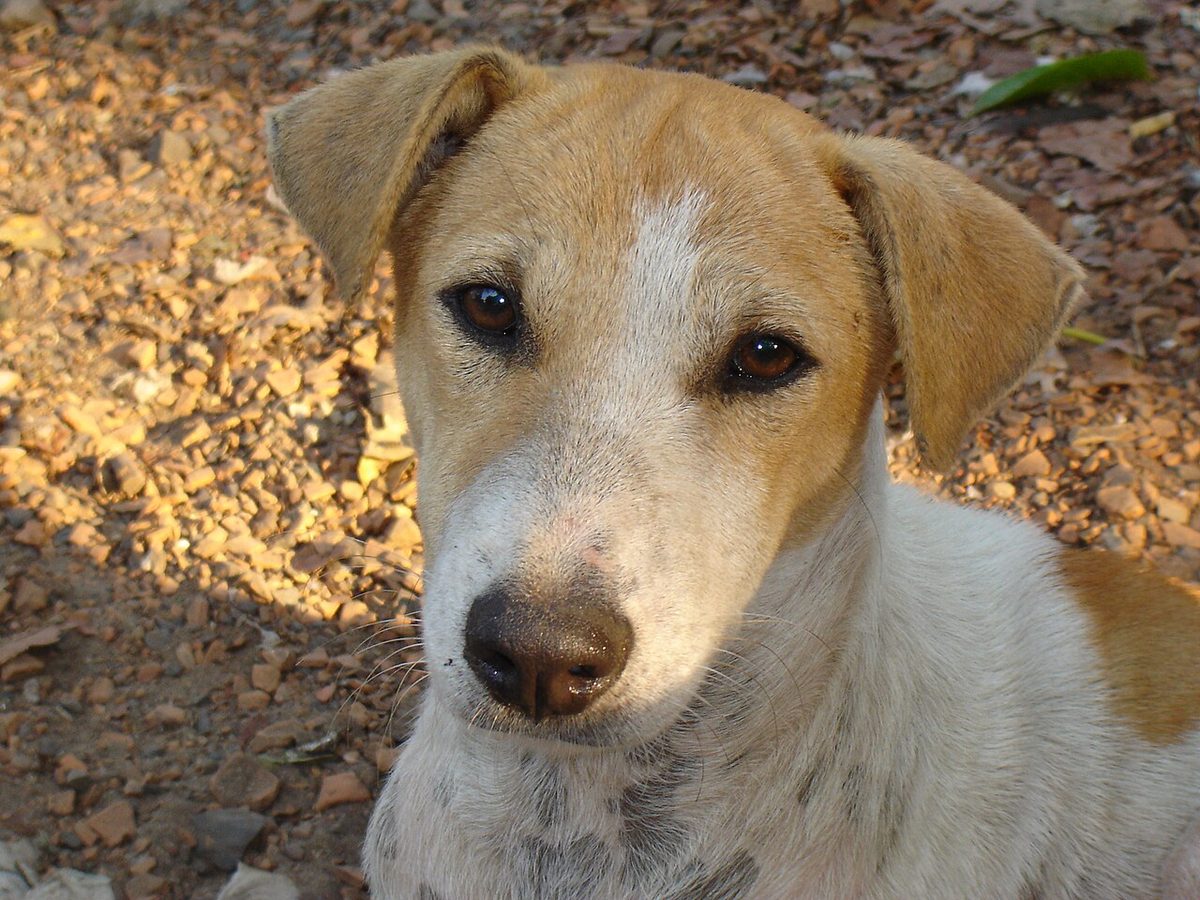
The Indian pariah dog is medium-sized, square to slightly rectangular in build. Males stand 51–64 cm (20–25 in) and females 46–58 cm (18–23 in); females weigh 15–25 kg (33–55 lb). The coat is short and double, with a coarse top layer and a soft undercoat.
The usual colors are browns, from dark to reddish-brown, with or without white markings. Some dogs are pied and a few are solid black. Brindle, solid white and Dalmatian-style spotting are not seen in pure populations and point to mixing with modern breeds.
The head is wedge-shaped with a pointed muzzle. The eyes are almond-shaped and dark brown. The ears are erect, broad at the base and pointed at the tip, and the tail is curled and carried high when the dog is excited.
Temperament
These dogs are very alert and social. They are territorial and defensive, which makes them good guards. They are highly intelligent and easy to train, and with good socialization as puppies they do well with families and children.
Care and health
Because the type evolved naturally, without inbreeding, it has very few health problems, and inherited conditions such as hip dysplasia are extremely rare. The dogs keep themselves fairly clean, have little body odor and need very little grooming. Among free-ranging dogs most deaths come from road and rail accidents, starvation, polluted water, tumors, snakebite or harm from people.
Facts on this page were checked against Wikipedia and may have changed since.