Basenji

- Origin
- Central Africa
- Type
- Primitive
- Size
- Small
- Height
- 40–43 cm (16–17 in)
- Weight
- 9.5–11 kg (21–24 lb)
- Coat
- Short and fine
- Colors
- Red and white, tricolor, or brindle and white
- Life span
- About 13–14 years
- Status
- Recognised by the FCI, AKC and The Kennel Club
The Basenji is a small hunting dog bred from stock that came from Central Africa, in the Congo region and neighboring tropical countries. It does not bark like most dogs. Because of the unusual shape of its larynx it makes a yodel-like sound instead, which has earned it the name barkless dog. The FCI classes it with the spitz and primitive types, while the American Kennel Club treats it as a hound.
History
The Basenji is a basal breed, older than the modern breeds of the 19th century, and genetic studies place it, with the dingo, near the base of the domestic dog family. Like the wolf, husky and dingo it carries only two copies of a gene for digesting starch, a sign that it arose before farming spread. It has been linked with the curly-tailed, prick-eared dogs shown in Egyptian murals up to 4,500 years old.
One of its local names refers to its habit of jumping straight up to spot quarry. A Basenji brought back from the Niger expedition of 1841 appears in an 1843 painting that belonged to Queen Victoria. Early attempts to establish the breed in England failed because the imported dogs died of disease; six brought from Sudan in 1923 all died after distemper shots in quarantine. Foundation stock was finally established in England in the 1930s and then in the United States. Nearly all Basenjis in the West probably descend from those few dogs. The AKC accepted the breed in 1943 and has reopened its stud book to new African imports twice since, in 1990 and from 2009 to 2013.
Appearance
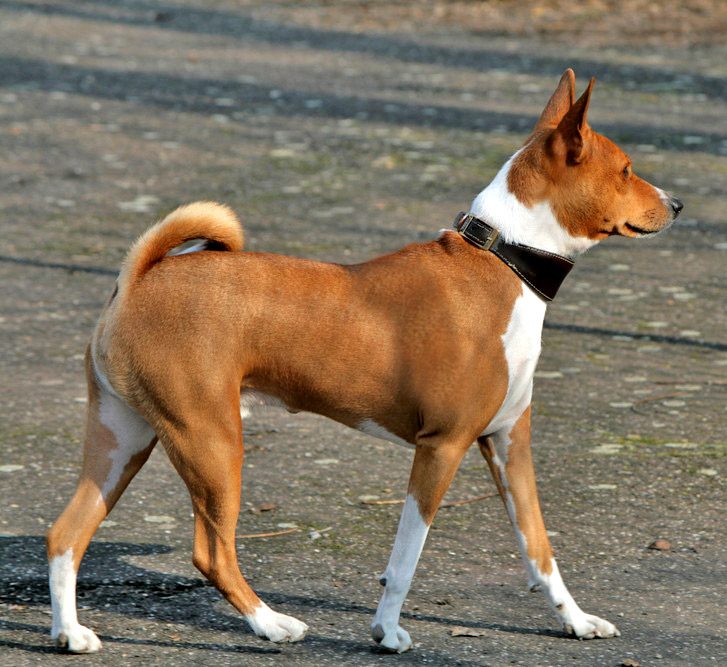
The Basenji is a short-haired dog with erect ears, an arched neck and a tightly curled tail. The forehead is wrinkled, more so in young or excited dogs, and the eyes are almond-shaped. Males average 43 cm at the withers and 11 kg, females 40 cm and 9.5 kg. Accepted colors are red and white, black and white with tan, and brindle and white. The stride is long, swift and tireless.
Temperament
In The Intelligence of Dogs the Basenji is ranked the second least trainable breed when asked to follow human commands, ahead of only the Afghan Hound.
Care and health
A 2004 UK Kennel Club survey found a median lifespan of 13.6 years, a year or two longer than other breeds of similar size; the oldest dog reached 17.5. The conditions owners reported most were dermatitis, incontinence and bladder infection, hypothyroidism, pyometra and infertility. Fanconi syndrome, an inherited kidney disorder, is unusually common in the breed. Some Basenjis carry a recessive gene for hemolytic anemia, for which there is a DNA test.
Facts on this page were checked against Wikipedia and may have changed since.