Basset Fauve de Bretagne

- Origin
- France
- Type
- Scenthound
- Size
- Small
- Height
- 32–38 cm (12.5–15 in)
- Weight
- 16–18 kg (36–40 lb)
- Coat
- Very rough, dense and fairly short
- Colors
- Fawn or red-wheaten
- Status
- Recognised by the FCI and AKC
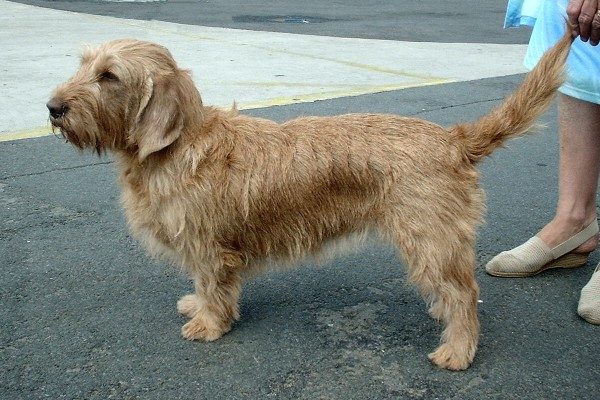
The Basset Fauve de Bretagne is a short-legged hunting dog of the scenthound type from Brittany, in France. It is a smallish, wire-coated hound, always some shade of fawn.
History
The breed was developed in France as a hunting dog from the larger Grand Fauve de Bretagne, which is now extinct. A story has long circulated that the Basset Fauve itself almost died out after the Second World War and was rebuilt from the few remaining dogs with the help of wirehaired Dachshunds. The French breed club rejects this and says numbers never fell so low. In 2002 there were 1,060 new registrations in France.
In the United Kingdom the breed is mostly a show dog and family pet. It came off the Kennel Club’s rare breed register in 2007, and fewer than 140 dogs are registered there each year. Elsewhere in Europe it is used for scent trailing and kept as a companion. The American Kennel Club gave the breed full recognition in 2026.
Appearance
The Basset Fauve is built along the lines of the Basset Hound but is lighter throughout and longer in the leg. It stands 32 to 38 cm tall and weighs about 36 to 40 lb. Mixed litters of Griffon and Basset Fauves were once registered together, a practice that was controversial, and as a result a basset litter sometimes includes long-legged dogs.
The coat is harsh, dense and wiry, in red-wheaten or fawn, sometimes with a white mark on the chest. The hair on the ears is shorter, finer and darker than on the body. The ears are pleated and reach just to the end of the nose instead of trailing on the ground. The eyes and nose are dark, and the front legs should ideally be straight. According to the French standard this is the shortest-backed of the basset breeds, so it looks less exaggerated than the British Basset.
Care and health
The coat repels dirt and does not mat easily, but it still needs combing and brushing every week, and it may need stripping.
A 2006 study found an inbreeding coefficient of 3.9 percent, the second lowest of the nine French breeds examined. The Basset Fauve de Bretagne is one of the breeds more commonly affected by primary open angle glaucoma, which in this breed is caused by a recessive mutation of the ADAMTS17 gene.
Facts on this page were checked against Wikipedia and may have changed since.