New Guinea Singing Dog
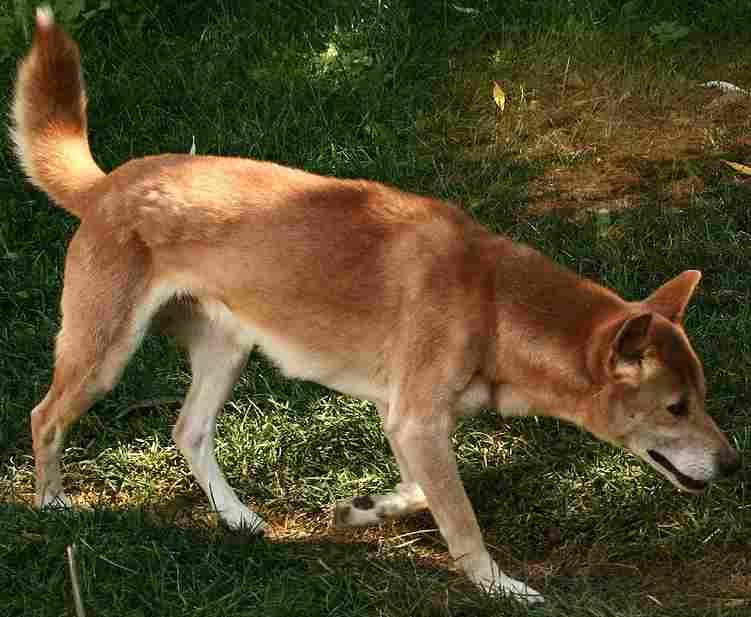

- Origin
- New Guinea
- Type
- Primitive
- Size
- Medium
- Height
- 31–46 cm (12–18 in)
- Weight
- 9–14 kg (20–31 lb)
- Colors
- Brown, black or tan, with white points
- Status
- Rare
The New Guinea singing dog is an ancient lineage of dog native to the New Guinea Highlands. It is closely related to the Australian dingo and was once classed as a species of its own, Canis hallstromi. It is one of the few dogs considered barkless, and it takes its name from its unusual howl.
History
Small dogs that neither barked nor howled were recorded on the south coast of New Guinea in 1606. The first specimen was collected on Mount Scratchley in 1897. In 1956 a pair was obtained in the Levani Valley and sent to Sir Edward Hallstrom and on to Taronga Zoo in Sydney; the captive dogs in the United States descend from the Taronga animals. Five more were captured in 1976 and sent to Germany, and there are also captive populations in Canada and the United Kingdom.
How the dog should be classified is still debated. A 2016 review found no firm evidence that the founders of the captive population were wild animals and not village dogs. A 2020 study found that the highland wild dogs living near Puncak Jaya, at around 4,000 m, are the population from which captive singing dogs derive, and are far more genetically diverse than the severely inbred captive dogs.
In the wild the dog is now apparently rare; there were no verified sightings between the 1970s and a photograph taken in 2012. Crossbreeding with other dogs is one of the most serious threats it faces.
Appearance
Compared with other dogs, the singing dog is fairly short-legged and broad-headed, and looks like a small dingo. It stands 31 to 46 cm at the shoulder and weighs 9 to 14 kg. The ears are erect, pointed and fur-lined, and the bushy tail reaches the hock and has a white tip. The eyes are almond-shaped, dark amber to dark brown, and glow bright green in low light. The limbs and spine are very flexible: the dog can spread its legs sideways to 90 degrees and climbs about as well as a cat.
Adults are brown, black or tan, all with white points under the chin and on the paws, chest and tail tip. Pups are born dark chocolate brown and lighten by six weeks.
Temperament
Wild sightings have been of single dogs or pairs, so the dogs do not seem to form lasting packs. They are described as extremely shy and canny. Their howl rises sharply in pitch at the start and ends at very high frequencies, and groups howl in chorus, most often in the morning and evening. Adults are very aggressive toward unfamiliar dogs, and dogs of the same sex may fight seriously in the breeding season.
A 2021 survey of North American owners found that singing dogs kept as companions behave like other ancient breeds, were less aggressive than many breeds in the study, and were about as trainable as Basenjis and Canaan Dogs.
Care and health
Captive singing dogs need no special diet but seem to thrive on lean raw meat. In New Guinea they are reported to eat small and medium-sized marsupials, rodents, birds and fruit.
Facts on this page were checked against Wikipedia and may have changed since.