Cão Fila de São Miguel
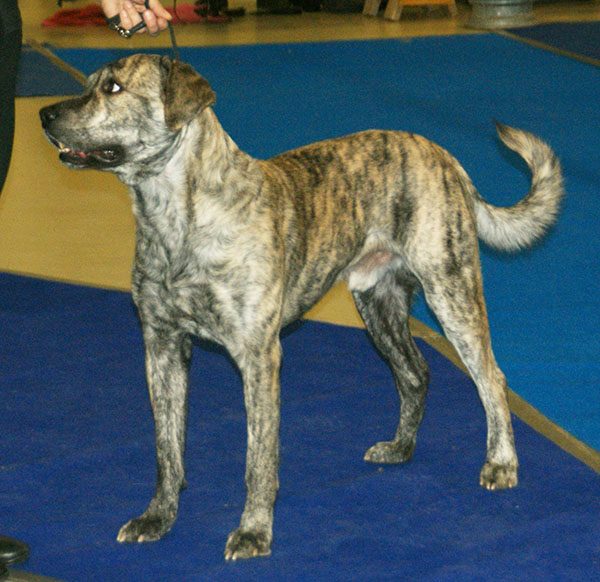

- Origin
- Azores
- Type
- Mastiff
- Size
- Large
- Height
- Up to 60 cm (23.6 in)
- Weight
- Up to 35 kg (77 lb)
- Coat
- Short, smooth and harsh
- Colors
- Fawn, brown or gray brindle
- Status
- Recognised by the FCI
The Cão Fila de São Miguel, or Saint Miguel Cattle Dog, is a mastiff-type dog from São Miguel Island in the Azores, the Atlantic island chain that is an autonomous region of Portugal. Its Portuguese name means “catch dog of São Miguel”, and it was originally used to work cattle.
History
The breed comes from São Miguel and is linked to the extinct Terceira Mastiff of the neighboring island of Terceira. It has been documented since the early 19th century. A breed standard was first published in 1984, and the FCI published it internationally in 1995 under the English name Saint Miguel Cattle Dog. Although it worked as a cattle dog, the FCI classes it with the molossoid breeds.
Dogs from São Miguel are now exported to North America and elsewhere, where they are bred for the rare breed market. Small clubs and individual breeders abroad sometimes write their own standards, which can differ from the island’s. In the United States and England the breed is known as the Azores Cattle Dog.
Appearance
This is a large dog but not an oversized one, standing at most 60 cm (23.6 in) at the withers and weighing up to 35 kg (77 lb), with females a little smaller. It is normally proportioned, deep-chested and muscular, with a broad head, a neck of medium length, a straight back and long legs. The tail is carried up in a slight curve.
The coat is short, smooth and harsh to the touch, with a short fringe on the tail and on the backs of the hind legs. It is always brindle: brown, pale fawn or gray with black. The ears hang naturally. By tradition they were cropped and rounded at the top and the tail was docked, but both practices are now illegal in many places.
Temperament
The breed is said to be intelligent, to bond closely with its keepers, and to be gentle and even docile when well trained. Individual dogs vary a great deal, and how well a dog suits a particular job depends much on its early training. Saint Miguel Cattle Dogs can take part in agility, obedience, flyball, tracking and herding events.
Care and health
Dogs from Portugal have no documented health problems. Dogs bred elsewhere are often much larger than the standard allows and may suffer the ailments of very large, deep-chested dogs, such as bloat.
Facts on this page were checked against Wikipedia and may have changed since.