Tornjak

- Origin
- Bosnia and Herzegovina
- Type
- Livestock guardian
- Size
- Large
- Height
- 60–70 cm (24–28 in)
- Coat
- Long and very dense, with a mane and breeches
- Colors
- Particolored, mostly white with patches of any color
- Status
- Recognised by the FCI
The Tornjak, also called the Bosnian-Herzegovinian Sheepdog, is a livestock guardian dog native to Bosnia and Herzegovina and Croatia. It is a mountain dog of molosser type, similar to other guardians of the region such as the Šarplaninac. The modern breed was re-created in the 1970s from dogs matching old descriptions.
History
The earliest written reference to the breed dates from the 11th century. Peter Horvat, Bishop of Đakovo, described the Tornjak in 1374, and Peter Lukić, a canon of the same diocese, in 1752. They wrote of intelligent guard dogs bred to keep aggression in check. In medieval Bosnia these were the dogs that traveled with the Vlach shepherds and their flocks.
As nomadic sheep herding came to an end, the Tornjak became scarce. In the early 1970s a group of dog experts began searching for dogs that fitted the historical accounts. Pure breeding started in 1978, with a foundation of genetically uniform landrace shepherd dogs found in that search. Tornjaks were first imported to the United Kingdom in 2013.
The name comes from “tor”, a sheep pen. The dogs are called Toraši around Sinj and the Kamešnica mountain, and Dinarci by the shepherds of the Dinara mountains.
Since 2010 Denmark has banned the owning, breeding and import of Tornjaks, which it classes as dangerous dogs.
Appearance
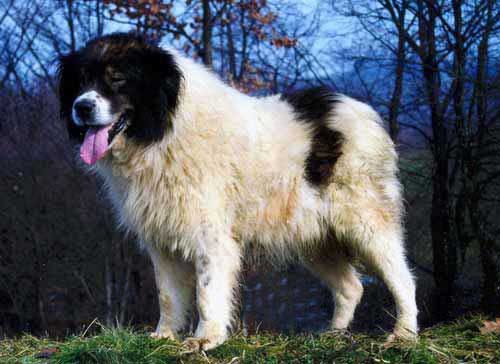
The Tornjak is a large, strongly boned dog, roughly square in build and agile in movement. Males stand 65 to 70 cm (26 to 28 in) and females 60 to 65 cm (24 to 26 in).
The coat is long and so dense that it cannot be parted. It is short on the face and legs, long and full around the neck, where it forms a mane, and on the backs of the thighs, where it forms breeches. The tail is well feathered and carried like a flag when the dog moves.
Tornjaks are usually particolored, with white as the main color and patches of any color. The markings were useful: they let shepherds tell their dogs from both the sheep and the wolves.
Temperament
An adult Tornjak is calm, peaceful and may seem indifferent, but it is a vigilant watchdog when needed. It is neither nervous nor aggressive, and it is affectionate with its family. In a pack the dogs are highly social and do not fight among themselves. They are tough, sturdy and undemanding.
When the flock is threatened, a Tornjak acts decisively and will take on a stronger opponent. Shepherds used to say that one Tornjak was a match for two wolves, and that a pair would chase off a bear.
Tornjaks learn quickly, remember well and are easy to train.
Care and health
The Tornjak does not need a great deal of exercise, especially during its first 9 to 12 months. It likes long walks off the leash and play with other dogs. Its thick coat lets it sleep outdoors on snowy winter nights without harm.
Facts on this page were checked against Wikipedia and may have changed since.