Alano Español
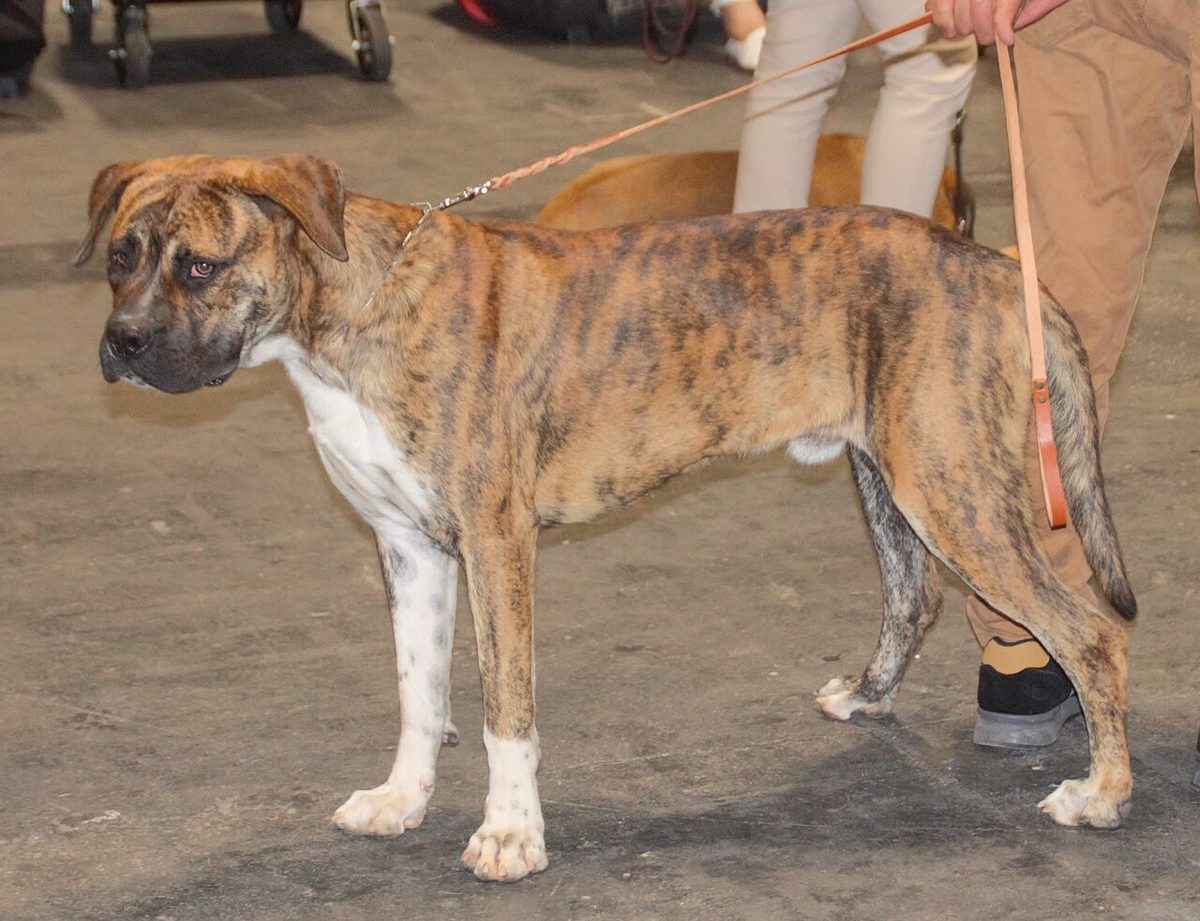

- Origin
- Spain
- Type
- Mastiff
- Size
- Large
- Height
- 55–63 cm (22–25 in)
- Weight
- 25–40 kg (55–88 lb)
- Coat
- Short and thick
- Colors
- Brindle of any shade, fawn from sand to red, or black-and-brindle
- Status
- Recognised by the Real Sociedad Canina de España and in Spanish law; not recognised by the FCI
The Alano Español, or Spanish Bulldog, is a medium to large Spanish dog of the alaunt or bulldog type. Over the centuries it has served as a war dog, a bull-ring dog, a cattle dog, a hunting dog and a guard. It came close to dying out in the twentieth century and has since recovered.
History
Nobody knows exactly where the Alano came from. One idea is that it descends from dogs that arrived in Spain in the fifth century with the Alani, a nomadic herding people. The earliest written mention in Spain is in the fourteenth-century Book of the Hunt of Alfonso XI, which describes hunting dogs called Alani and praises their colors.
Dogs of this kind sailed with Spanish explorers and were used as war dogs against Native American peoples and to recapture escaped slaves. They also worked in the bull-ring, as an 1816 etching by Francisco de Goya shows.
The decline began in the late nineteenth century. Dogs were banned from the bull-ring in 1880, hunters turned to imported breeds, open-range cattle keeping shrank, and slaughterhouses stopped using dogs. With its old jobs gone, the Alano nearly disappeared.
In the 1980s a surviving breeding population was found in the mountains of Las Encartaciones in the Basque Country. A standard was written, a stud-book was opened, and a recovery project began with the help of the Real Sociedad Canina de España and several town councils. Two breed societies now exist, one of them founded in 1995. In 2004 the Spanish ministry of agriculture added the Alano to its list of native Spanish breeds. The Fédération Cynologique Internationale does not recognise it. The Cimarrón Uruguayo of Uruguay may descend mainly from the Alano.
Appearance
Females stand about 55–60 cm at the withers and weigh roughly 25–30 kg. Males are on average some 3 cm taller and 5 kg heavier.
The head is large, strong and squarish, with a short muzzle that makes up a little over a third of its length. The lower jaw curves slightly, and a mildly undershot bite is tolerated. The ears sit high and hang down unless they have been cropped. The skin is very thick, with folds at the neck and some wrinkles on the face.
The coat is short and thick, never velvety. Brindle is the most common color and may be of any shade, including gray or blue. Fawn runs from sand to red. There is also a black-and-brindle pattern, which is a black-and-tan with brindled tan areas. A black mask may or may not be present, and the nose is black. A little white on the neck, chest or paws is accepted, but a lot of white is discouraged.
Temperament
Because the Alano was hunted in packs, it gets along well with other dogs. Its traditional work was demanding: hunting boar and deer, guarding, and handling cattle at pasture and in slaughterhouses.
Facts on this page were checked against Wikipedia and may have changed since.