Karakachan Dog
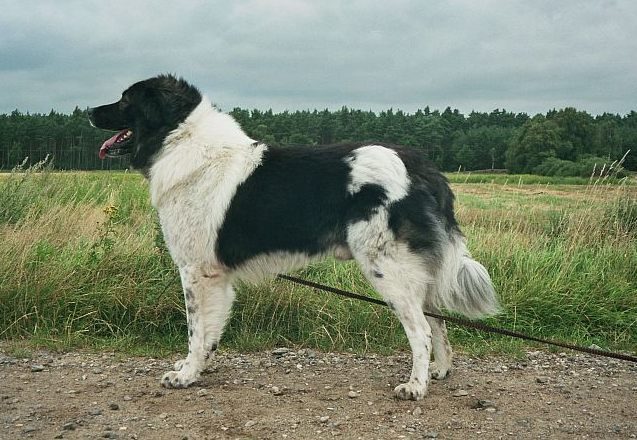

- Origin
- Bulgaria
- Type
- Livestock guardian
- Status
- Recognised as a native breed in Bulgaria; rare
The Karakachan Dog is a livestock guardian from Bulgaria. It is related to the guardian dogs of the neighboring countries, and takes its name from the Karakachans, nomadic Greek shepherds of the Balkans. It was kept to protect flocks and property, and it will take on a wolf or a bear to do so, which earned it the name of wolf killer.
History
The breed is said to descend from the dogs of the Thracians, who were noted stock-breeders, with its ancestors taking shape as early as the third millennium BC. The Karakachans kept to conservative ways of raising animals, and so preserved some of the oldest domestic breeds in Europe: the Karakachan sheep, the Karakachan horse and the Karakachan dog. The word Karakachan most likely comes from the Turkish kara, black, and kaçan, one that got away.
The dog appears under this name in the work of the Bulgarian writers Yordan Yovkov, Georgi Raitchev and Yordan Radichkov. H. B. Peters wrote about it in a German dog journal in 1938. Its first researcher was Todor Gajtandjiev, who proposed a standard in the 1970s.
The Karakachan was later used as a watchdog by the Bulgarian border army. It came close to disappearing, and survived through the dedication of shepherds in the mountains. A standard was written in 1991 and approved in 2005 by the Bulgarian state commission for animal breeds, when the dog was officially recognized as a native Bulgarian breed.
Today it works mainly as a livestock guardian and property guard. The largest numbers of working purebred dogs are in Bulgaria and the United States. The Karakachan is part of the ancestry of the Bulgarian Shepherd, but the two are not the same breed. Nor is it the same as the giant show dogs that some Bulgarian fanciers are creating by crossing Karakachans with breeds such as the Caucasian Ovcharka, Saint Bernard and Newfoundland.
Temperament
The Karakachan is strictly territorial, and its territory is the flock, wherever the flock happens to be. Near the sheep it becomes visibly aggressive when they are threatened, and seriously so if a stranger tries to take an animal. Yet when a flock passes through a village, the dogs walk calmly and ignore people.
Some dogs are excellent guards against predators without being aggressive toward people, and breeding now tends toward dogs of that kind.
The dogs are effective at their work. In one Bulgarian project that has placed dogs with flocks since 1998, only three successful predator attacks were recorded. In one of them, shepherds had split a flock of 650 sheep and left half without dogs.
Facts on this page were checked against Wikipedia and may have changed since.