Dalmatian
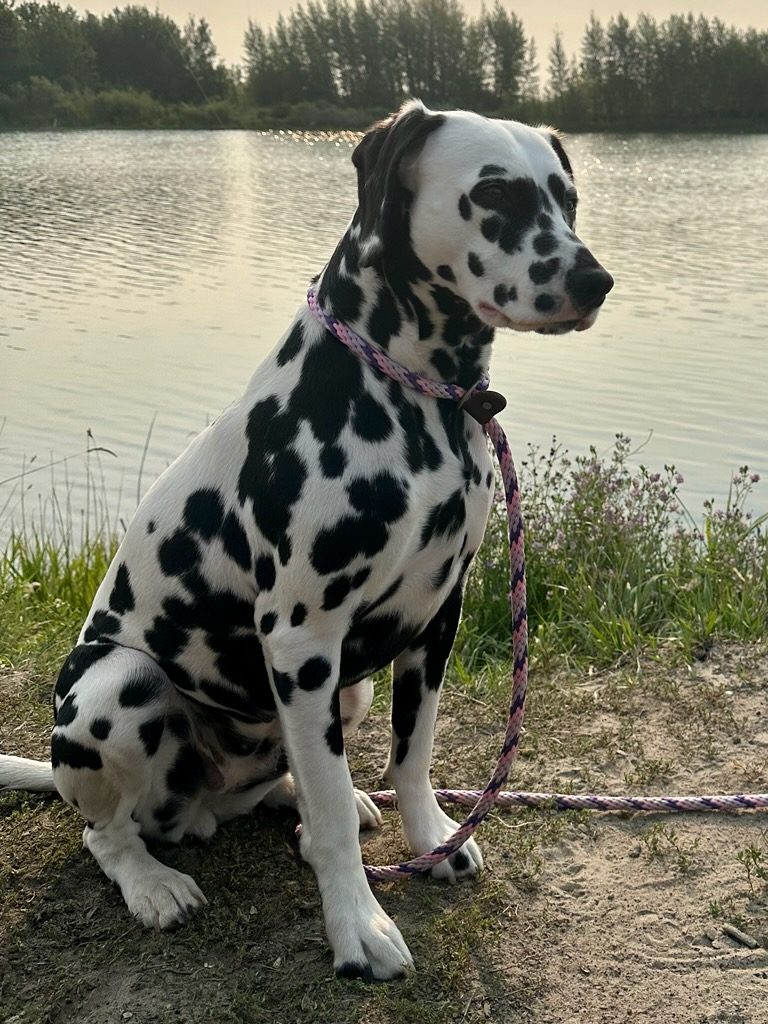

- Origin
- Croatia
- Type
- Other
- Size
- Medium
- Height
- 48–58 cm (19–23 in)
- Coat
- Short, fine and dense
- Colors
- White with black or liver spots
- Life span
- About 13 years
- Status
- Recognised by the FCI, AKC and The Kennel Club
The Dalmatian is a white dog covered in dark spots, with origins traced to Croatia and the historical region of Dalmatia. It was first bred as a hunting dog and later became a carriage dog, most famously running with the horse-drawn engines of fire brigades. Its early ancestors are thought to include certain pointers and a spotted Great Dane.
History
The first known written mention dates from 1375, when Peter, Bishop of Đakovo, described a hunting dog found mainly in Dalmatia, with short white hair and round black spots, and called it Canis Dalmaticus. The earliest pictures of the breed are also in Croatia: an altar painting in Veli Lošinj from 1600–1630 and a fresco in Zaostrog. Thomas Pennant used the name Dalmatian in 1771. The FCI recognizes Croatia as the country of origin.
The breed was developed chiefly in England. During the Regency period it was a status symbol. It was first shown in England in 1862. Vero Shaw wrote an unofficial standard in 1882, which became official in 1890 when the first Dalmatian Club was formed.
Dalmatians have been hunting dogs, dogs of war, ratters, retrievers and circus performers. Because they get on well with horses, they were easily trained to run ahead of fire carriages and clear a path.
The 1956 novel The Hundred and One Dalmatians and the Disney films based on it brought a huge surge in popularity. Many dogs were later abandoned to shelters, and AKC registrations fell 90% between 2000 and 2010.
Appearance
The Dalmatian is a muscular dog with great endurance. The AKC standard gives a height of 48–58 cm (19–23 in).
Puppies are born plain white, and the first spots usually appear within 10 days, continuing to develop until about 18 months. Spots are usually 2–6 cm across and black or liver on white. Black-spotted dogs have black noses and liver-spotted dogs brown ones. Other colors, such as lemon, orange, blue and tricolor, turn up now and then.
The coat is short, fine and dense. Long-coated puppies are sometimes born but are not accepted by the standard.
Temperament
The Dalmatian is an intelligent dog with strong hunting instincts, and it keeps a high guarding instinct to this day.
Care and health
Dalmatians shed heavily all year, and the short, stiff hairs work their way into fabric. Weekly grooming with a hound mitt reduces this. The coat carries little oil, so the dogs have almost no doggy smell.
Deafness is the breed’s best-known problem. Studies in the UK, Switzerland, Germany and the US found between 16.5% and 25.7% of Dalmatians deaf in one or both ears.
Dalmatians also have trouble breaking down uric acid, which can lead to gout and to kidney and bladder stones, most often in middle-aged males. The normal gene is absent from the pure breed, which led to the Dalmatian-Pointer Backcross Project, begun in 1973 with a single English Pointer. The AKC agreed to register the backcrossed dogs in 2011.
Other conditions include autoimmune thyroiditis, atopic dermatitis, solar dermatosis and squamous cell carcinoma. A 2024 UK study found a life expectancy of 13.2 years.
Facts on this page were checked against Wikipedia and may have changed since.