Bull and Terrier
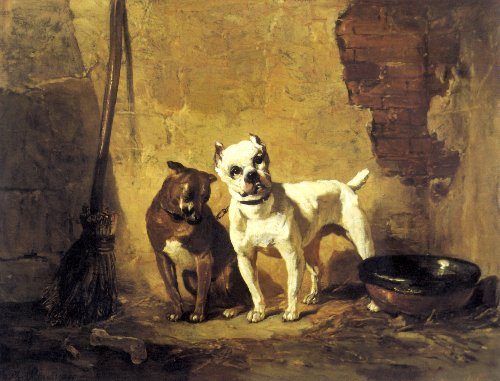

- Origin
- Great Britain
- Type
- Crossbreed
- Status
- Extinct
Bull and terrier was the common name in the early 1800s for crosses between bulldogs and terriers. It was never a true breed. The name covered a mixed group of dogs, some purebred and some crossed, that were bred in Britain and Ireland for blood sports, and which are regarded as the forerunners of several modern breeds. They were also called half-and-halfs, half-breds, pit dogs, bulldog terriers and, most often, bull-terriers.
History
Baiting sports called for a brave, tenacious dog with a wide, heavy-boned frame and a strong jaw. By crossing bulldogs with various terriers, breeders added gameness and agility. Little is known about the pedigrees of these dogs. Types varied from place to place according to local taste, with some breeders wanting more terrier in the mix and others more bulldog. In Ireland the old Irish bulldog was crossed with different terriers. In England there were several varieties, among them the Walsall and Cradley Heath types.
From the mid-1830s the ban on bull-baiting was enforced, and the original bulldog lost popularity. Breeders went on crossing bulldogs with terriers for dog fights held out of sight in basements and warehouses.
Bull and terriers were also used against vermin. Rat-baiting was a popular blood sport in 19th-century Britain, London above all, in which a dog was timed as it killed rats in a pit. A black and tan bull and terrier named Jacko, who weighed about 13 lb and belonged to Jemmy Shaw, set records in 1862, beating the times of an earlier celebrated dog named Billy. The black and tan dogs were bred from the Old English Bulldog and terriers, mostly of the black and tan Manchester type. Some writers of the period held that the best working terriers owed their courage to bulldog blood.
Two early fighting dogs were pictured in The Sporting Magazine. Trusty, shown in 1806, was fawn, looked more bulldog than terrier and was said to have won 104 fights. Dustman, shown in 1812, was more of a terrier and was used on badgers.
Descendants
In Birmingham, James Hinks helped turn the cross into a standard breed. He is said to have brought in other breeds to lengthen the muzzle and whiten the coat, and he showed his new Bull Terrier in 1862.
The Cradley Heath type became the Staffordshire Bull Terrier. Immigrants took the Walsall type to the United States in the 19th century, where, combined with Irish strains, it became part of the foundation of the American Pit Bull Terrier. Six breeds are counted as descendants: the Bull Terrier, Boston Terrier, American Staffordshire Terrier, Staffordshire Bull Terrier, Miniature Bull Terrier and American Pit Bull Terrier.
A genome study in 2017 traced all of the bull and terrier crosses to the terriers of Ireland, and dated them to 1860–1870.
Appearance
There was no single look. A writer in the 1930s, going by old prints, said the early dogs resembled the bulldog of their day more than the terrier: they had the bulldog’s head, less exaggerated than it later became, and the straighter, longer legs of the terrier.
Facts on this page were checked against Wikipedia and may have changed since.