Basset Hound

- Origin
- Great Britain
- Type
- Scenthound
- Size
- Medium
- Height
- 28–38 cm (11–15 in)
- Weight
- 20–34 kg (45–75 lb)
- Coat
- Smooth, short and close
- Colors
- Usually tricolor (black, white and tan) or bicolor (tan or lemon and white); any hound color
- Life span
- 10–12 years
- Status
- Recognised by the FCI and The Kennel Club
The Basset Hound is a short-legged scent hound, developed in Great Britain from several French basset strains that no longer exist. It was bred mainly to hunt rabbit and hare, moving slowly enough for hunters to keep up on foot without horses. Its nose and its ability to follow a scent along the ground are second only to the Bloodhound’s. The name comes from the French bas, meaning low.
History
The basset type began in France. It is traced back to the hounds of St Hubert of Belgium in the sixth century, which were developed at the Abbey of St Hubert into the St Hubert’s Hound by about 1000 AD. Short-legged hounds are thought to have first appeared as a mutation in litters of Norman Staghounds, a descendant of that hound.
The first mention of a basset is in a French hunting book of 1585, where the dogs are used on foxes and badgers. Until the French Revolution, hunting on horseback was reserved for royalty and the gentry, so low-set hounds that could be followed on foot were valued.
Bassets became fashionable under Napoleon III, and drew international notice at the first Paris dog show in 1863. Controlled breeding of the short-haired basset began in France in 1870 and produced the original Basset Artésien Normand.
French bassets were reaching England by the 1870s. In the 1890s Everett Millais, regarded as the father of the modern breed, crossed one of his bassets with a Bloodhound by artificial insemination to produce a heavier dog. The surviving puppies were bred on with French and English bassets. The first standard for the Basset Hound was written in Britain at the end of the nineteenth century and was updated in 2010.
Appearance
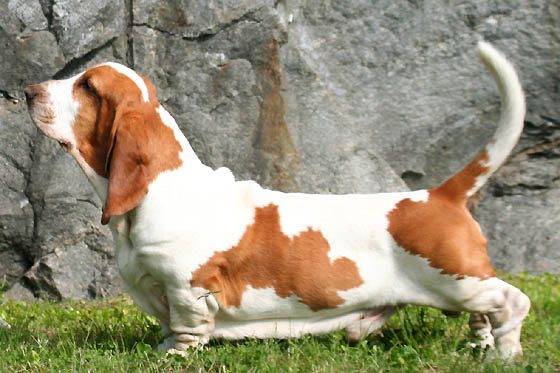
A Basset Hound is built like a large dog on short legs. For its size it is heavier-boned than any other breed. Weight varies between bloodlines but averages 20–35 kg (44–77 lb). The back is long, and the slightly curved tail is carried high. The front legs are a little crooked, which helps support the broad chest.
The skin is loose and wrinkled, giving the face a sad look, and hangs in a dewlap at the neck. The long ears help stir up scent from the ground.
The coat is short, with coarser hair under the tail. All hound colors occur except merle and brindle. Tricolors are the most popular, and red and white is also common.
Temperament
Basset Hounds are friendly, outgoing and playful, and they are tolerant of children and other pets. They are typically mild and very devoted without being timid.
Care and health
The breed’s short legs are the result of osteochondrodysplasia, a genetic condition that stunts growth and affects movement.
Median lifespan is 10–12 years. A 2024 study in the United Kingdom found a life expectancy of 12.5 years. In a 2004 Kennel Club survey the leading causes of death were cancer, old age, gastric dilatation volvulus and heart problems.
Basset Hounds are predisposed to gastric dilatation volvulus and are among the breeds most often affected by primary open angle glaucoma. They are prone to yeast infections and to skin and ear conditions including allergic skin disease, intertrigo, Malassezia dermatitis and otitis. An inherited platelet disorder, Basset Hound hereditary thrombopathy, also occurs in the breed.
Facts on this page were checked against Wikipedia and may have changed since.