Afghan Hound
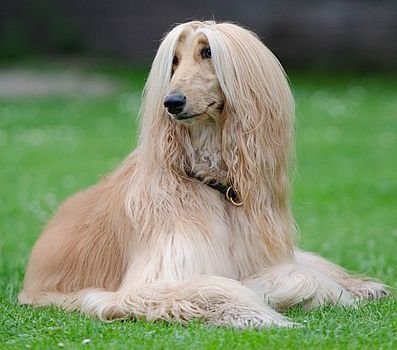

- Origin
- Afghanistan
- Type
- Sighthound
- Size
- Large
- Height
- 61–74 cm (24–29 in)
- Weight
- 20–27 kg (44–60 lb)
- Coat
- Long, fine and silky
- Colors
- Any color
- Life span
- About 11 years
- Status
- Recognised by the FCI, AKC and The Kennel Club
The Afghan Hound is a tall sighthound from the cold mountains of Afghanistan, where it was bred for speed and for hunting game. Its thick, fine coat grew as protection against the mountain climate, and its large paw pads cushioned it on rocky ground. It is no longer used for hunting, though it still takes part in lure coursing.
History
Genetic studies place the Afghan Hound among the basal breeds, older than the modern breeds that took shape in the 19th century, and its closest relative is the Saluki. The name Tazi points to a shared ancestry with the similar Tazy of the Caspian region.
Sighthounds of this kind reached England in the 1800s with army officers returning from British India, and were shown under names such as Barukzy hound and Persian Greyhound. A dog called Zardin, brought from India in 1907, became the model for the first breed standard in 1912, but the First World War ended that line of breeding.
The modern breed rests on two strains. The Bell-Murray strain came to Scotland from Balochistan in 1920 and was of the lighter-coated steppe or desert type. The Ghazni strain, from Mary Amps’s kennel in Kabul, reached England in 1925 and was the heavily coated mountain type; most Afghans in the United States descend from it, as did the first imported to Australia in 1934. The two were blended, and a new standard written in 1948 is still in use. In 2005 an Afghan Hound named Snuppy became the first cloned dog.
Appearance
The Afghan Hound stands 61–74 cm (24–29 in) and weighs 20–27 kg (44–60 lb). The coat is long and fine, with a long topknot on the head and a saddle of shorter hair along the back. High hipbones and a small ring at the end of the tail are typical of the breed. Any color is allowed, though white markings, especially on the head, are discouraged, and many dogs have a black facial mask. Some have a beard on the lower jaw, called a mandarin.
Temperament
The typical Afghan Hound is aloof and dignified, but happy and clownish at play. Like other sighthounds it has a strong prey drive and may kill small animals and livestock. Trainers regard it as slow to obey: in Stanley Coren’s The Intelligence of Dogs it ranked last for understanding and following commands.
Care and health
The long coat needs considerable grooming. A UK study found a life expectancy of 11.1 years. The main health problems are allergies, cancer and hip dysplasia, and like other sighthounds the breed is sensitive to anesthesia because it carries little body fat. Afghan Hounds are among the breeds most likely to develop chylothorax, which can lead to lung-lobe torsion and is often fatal. Other conditions recorded in the breed include laryngeal paralysis, dilated cardiomyopathy, hypothyroidism, central diabetes insipidus, cataract, corneal dystrophy, progressive retinal atrophy and Afghan myelopathy.
Facts on this page were checked against Wikipedia and may have changed since.